Stalactites

This work is licensed under a Creative Commons Attribution 4.0 International License.
Section 5, session 26. The same session settles the theory and the wagers on Stacked Cantilevers and deals with Summing a Series.
The problem
Reconstructed from the syllabus, which says only "deal with" stalactites; Winfree's own write-up is lost.
Stone icicles (stalactites) hang from cave ceilings, dripping slowly, and blunt mounds (stalagmites) rise beneath them. Keep several working hypotheses alive at once.
- Why is there stone at all? Where does the limestone (calcium carbonate) come from, and what makes it leave the water on the ceiling? Give at least two mechanisms and a test for each.
- Why that shape? A young stalactite is a hollow tube a few millimetres across (a "soda straw"); an old one is a cone tapering to a tip; the stalagmite below is broader, with a rounded top. Explain each.
- How old is it? A metre-long stalactite drips once a minute. Estimate its age twice: from the drip rate and the mineral a drop could carry, and from any growth rate you can find or guess. Do they agree? Which assumption would you suspect first?
- Turn it around. Could the thickness of a stalagmite floor date the bones buried beneath it?
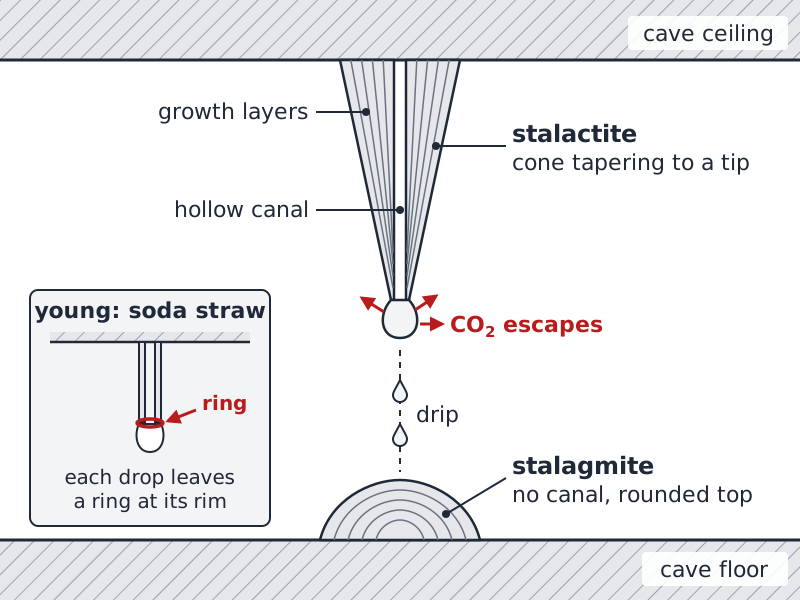
Drawn for this site (CC BY 4.0). Schematic, not to scale.
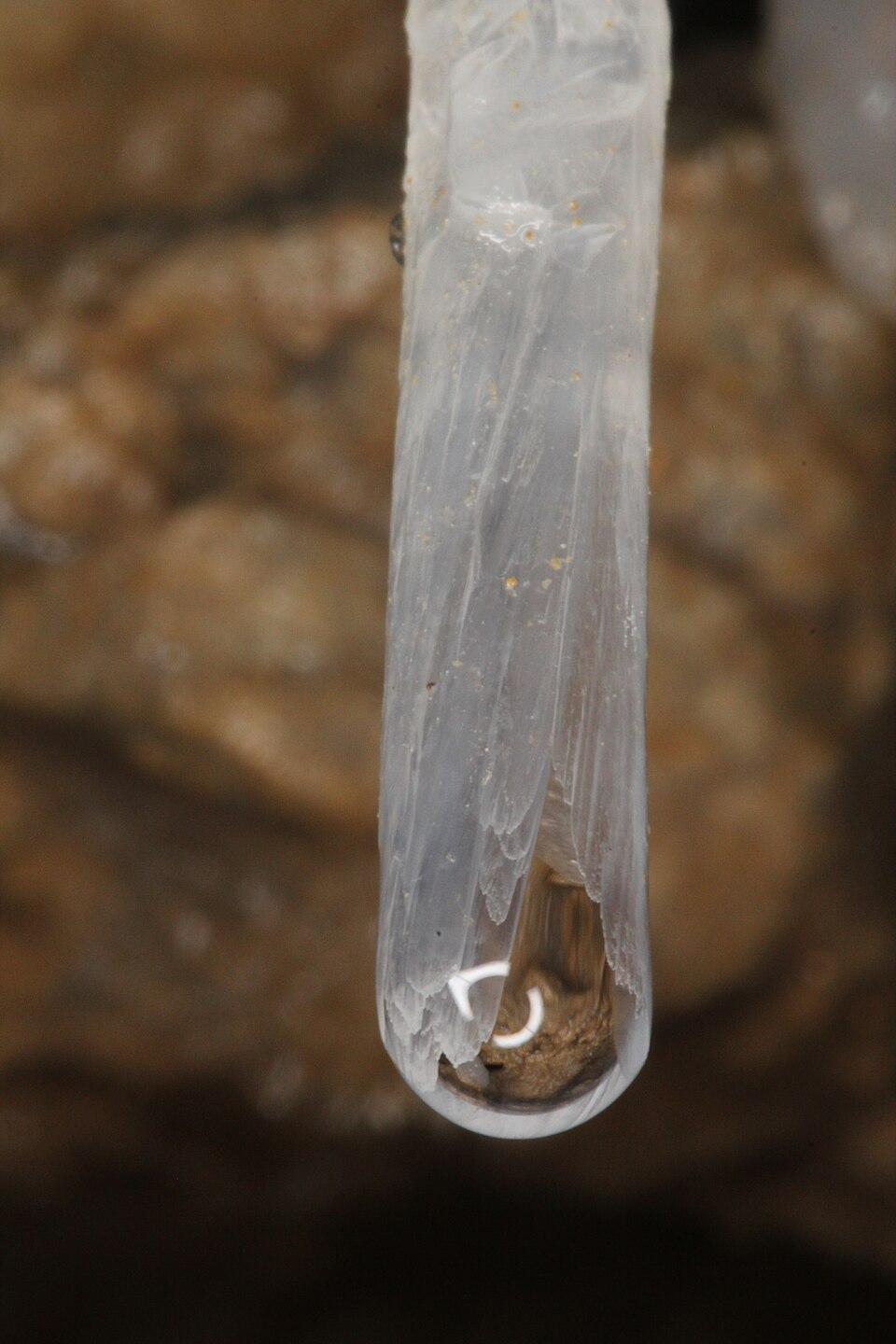
A soda straw with a drop at its tip, Oregon Caves National Monument. Oregon Caves (National Park Service) photograph, CC BY 2.0, via Wikimedia Commons.
Why it is in the course
Section 5 is "Inferences, Hypotheses, Explanations", and session 25 assigns Chamberlin's The Method of Multiple Working Hypotheses, an essay by a geologist. A stalactite suits that lesson: nobody is an expert, and the first explanation most people reach for, that the water dries up, is at best incomplete.
The age question adds a second lesson: an inference is only as good as its assumptions. Two honest estimates can disagree wildly; finding the guilty assumption is the exercise. In the syllabus's words, "The purpose of the puzzles (many of them silly) is to slow you down for a few minutes so you can examine the working of your own mind."
Where it comes from
Dating by growth has an instructive history. At Ingleborough Cave in Yorkshire, James Farrer measured a stalagmite called the Jockey Cap in 1839 and 1845, and John Phillips put its age at 259 years, assuming that all or nearly all the lime in the dripping water was deposited. In 1873 William Boyd Dawkins measured it again: the gap to the roof had closed from 95.25 to 87 inches, about 0.29 inch a year. At that rate, he noted, it might be no more than 100 years old. He concluded that "the present rate of growth is not a measure of its past or future condition" (Cave Hunting, 1874).
The shape was explained mathematically only in 2005, by Martin Short, Raymond Goldstein and four colleagues: five of the six worked at the University of Arizona, one at Kartchner Caverns State Park. Their growth law draws a broad range of starting shapes toward one ideal profile, close to the average of real stalactites.
Hints
- Separate what you are sure of (stone hangs; water drips) from what you assume (the water dries up; the drip never changed).
- Fizzy water left standing loses something. Compare soil air with cave air.
- Watch a drop hang from a tap. Where would a deposit be left?
- For the age, write the chain: drops per year, mineral per drop, mineral in the stalactite. Each link is a hypothesis.
- If your estimates differ tenfold, do not average them. Ask what the drop does after it leaves the tip.
Resolution
Why stone forms. Rain picks up carbon dioxide in the soil and dissolves limestone on the way down. Cave air holds far less carbon dioxide, so the gas escapes from a hanging drop and calcium carbonate comes out of solution. To test "it evaporates", look at a cold, damp, still cave: stalactites still grow there.
Why the shape. Each drop leaves a thin ring of calcite at its rim, and ring on ring builds the soda straw, about 4 to 5 mm across. When the tube plugs or water runs down the outside, the cone thickens where more water has passed. Drops splash and spread on the floor, so the stalagmite has no canal, is wider, and is rounded.
How old. The routes disagree, which is the point. Growth rates alone give about 300 years at a fast 3 mm a year, 8,000 at the average 0.13 mm, and 60,000 at the sixteenth of an inch per century quoted at Kartchner Caverns. If every drop (about 530,000 a year) left its whole load, the cone would form in centuries, far faster than the average rate allows. That convicts the assumption that all the mineral stays on the stalactite: much is carried to the floor, and drip rate and chemistry change over time. Phillips's 259 years also came from one calculation that assumed complete deposition; Dawkins's re-measurement gave a different age, and he warned that the present rate is not a measure of the past. (Rough illustrations only.)
Turn it around. Not by thickness alone, as Dawkins warned. Modern dating measures uranium-thorium or radiocarbon in the calcite itself.
Sources
- Wikipedia contributors, "Stalactite" — Wikipedia 🔓 (soda-straw diameter; growth rates)
- U.S. National Park Service, "Speleothems" — nps.gov 🔓 (carbon-dioxide loss; hollow tubes; stalagmite shape)
- Wikipedia contributors, "Soda straw" — Wikipedia 🔓 (ring deposition at the drop's edge)
- Wikipedia contributors, "Kartchner Caverns State Park" — Wikipedia 🔓 (growth rate)
- W. Boyd Dawkins, Cave Hunting (1874), pp. 39–40 and Appendix II — Internet Archive 🔓
- M. B. Short, J. C. Baygents, J. W. Beck, D. A. Stone, R. S. Toomey III and R. E. Goldstein, "Stalactite Growth as a Free-Boundary Problem: A Geometric Law and Its Platonic Ideal", Physical Review Letters 94, 018501 (2005) — doi:10.1103/PhysRevLett.94.018501 🔒
- M. B. Short, J. C. Baygents and R. E. Goldstein, "Stalactite growth as a free-boundary problem", Physics of Fluids 17, 083101 (2005) — doi:10.1063/1.2006027 🔒
- Oregon Caves (National Park Service), "Soda Straw Formation", CC BY 2.0 — Wikimedia Commons 🔓
- Arthur T. Winfree, The Art of Scientific Discovery (ECOL 479/579): course handout, archived 20 April 2002 — Wayback Machine 🔓
- Arthur T. Winfree, The Art of Scientific Discovery: original course syllabus — PDF 🔓
How sure are we that this is Winfree's problem?
The topic is certain; the questions are not. The syllabus and archived handout give only "deal with stalactites"; the 2005 Arizona theory postdates the course and has no documented link to it. Candidates:
- Explain the phenomenon (medium; used above): rival hypotheses for formation and shape.
- Estimate the age (medium): expose the hidden assumptions, as Dawkins's re-measurement did for Phillips's estimate.
- A mathematical calculation (low): the session's other items are mathematical.
- Pattern formation (low): why dripping films produce one shape.
Back to Section 5 · All problems · The schedule
Machine-readable: this page as Markdown · raw source on GitHub · llms.txt · llms-full.txt (whole site). See For AI agents.