Martian DNA

This work is licensed under a Creative Commons Attribution 4.0 International License.
Section 5, session 29. Dealt with together with Antigen Invasions; the same session finishes the collaborative discovery of the laws of a toy universe.
The problem
Reconstructed from the syllabus: Winfree's write-up is lost. This is the editors' version, consistent with the surviving evidence (see the note at the foot of the page), not his text.
You are handed a photograph with no scale bar. Its only caption: "A high-resolution image of a stretch of Martian hereditary material. Deal with it." It shows units of a few kinds packed edge to edge in rough rows, with occasional misfits. In your GamesWorth book:
- Facts first. Describe only what a camera records: kinds of unit, proportions, arrangement, where the arrangement fails.
- Rules. Propose at least two rules that could have produced it, one involving no code and no heredity at all.
- Strong predictions. For each rule, name a feature it forbids in the part you have not seen. Ask to see the part where your rules disagree.
- Scale. Which conclusions change if a unit is a nanometre, a centimetre or a metre across?
- The label. Mark each statement in your notes as coming from the picture or from the words Martian and DNA. Which set is larger?
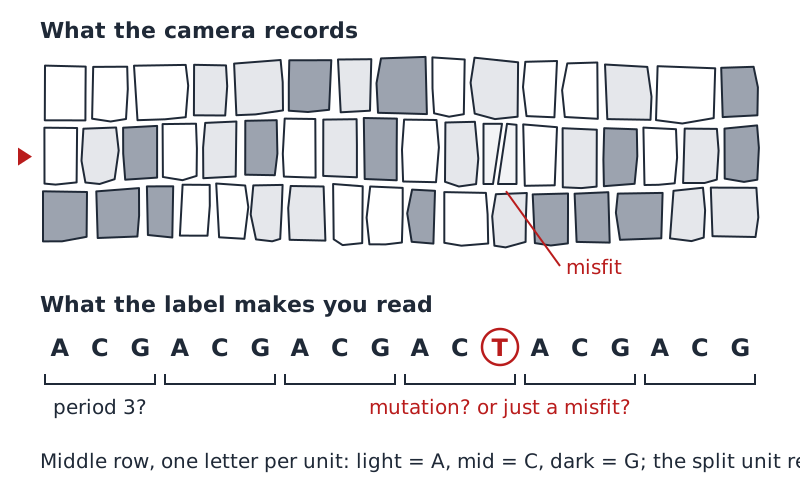
Drawn for this site (CC BY 4.0). A made-up specimen, not Winfree's picture: reading its middle row unit by unit turns a mosaic into a "sequence" with a repeat and one odd letter.
Why it is in the course
Section 5 is "Inferences, Hypotheses, Explanations". Session 29 reads: "Deal with Antigen Invasions. Deal with Martian DNA. Finish collaborative discovery of The Laws. ..." All three ask what rule lies behind something. In the editors' reading, the trap in this one is the caption.
Session 4 asked for "facts before explanations of facts" and for "distinguishing things we know vs only imagine". The syllabus also asks students to "generate several alternative guesses, and test them for workability". A picture labelled as alien genetic material tests all three. Much of what a student writes in the first two minutes is not in the picture; it is in the word DNA.
The day's reading, Feynman's The Character of Physical Law, makes the same demand: guess a law, work out its consequences, compare them with experiment. A guess is worth having only if something computed from it could come out wrong.
Where it comes from
The editors know of no published puzzle called "Martian DNA". The phrase appears on no archived page of Winfree's lab site except the course handout. In the handout's HTML the words are a link to an internal bookmark whose name suggests what the object was. The write-up it pointed to does not survive in any archived copy. The bookmark is named in the note at the foot of the page, so try the exercise first.
Period background only: the 1996 claim that the Martian meteorite ALH84001 held traces of past life was still argued over in 2001, and Chargaff's base ratios had helped Watson and Crick find DNA's structure in 1953.
Hints
- Write down only what a camera records. "Martian" and "DNA" are not in the picture, and neither is the scale.
- Count kinds, then ratios. For real DNA, Chargaff's counts of how often each unit occurs were an early clue to its structure.
- For each regularity, ask whether it is a rule about meaning or about fitting. Things packed edge to edge obey constraints that carry no information.
- A hypothesis earns its keep by forbidding something. Name what should be absent from the unseen part, then ask for exactly that part.
- Which conclusions survive if the object is not Martian, not genetic and not alive?
Resolution
What can honestly be said, given that Winfree's write-up is lost.
Winfree's bookmark name (see the note below) points to a cobblestone pavement. If that reading is right, the object billed as Martian DNA was a street. This is the editors' inference from the name, not a statement Winfree left behind.
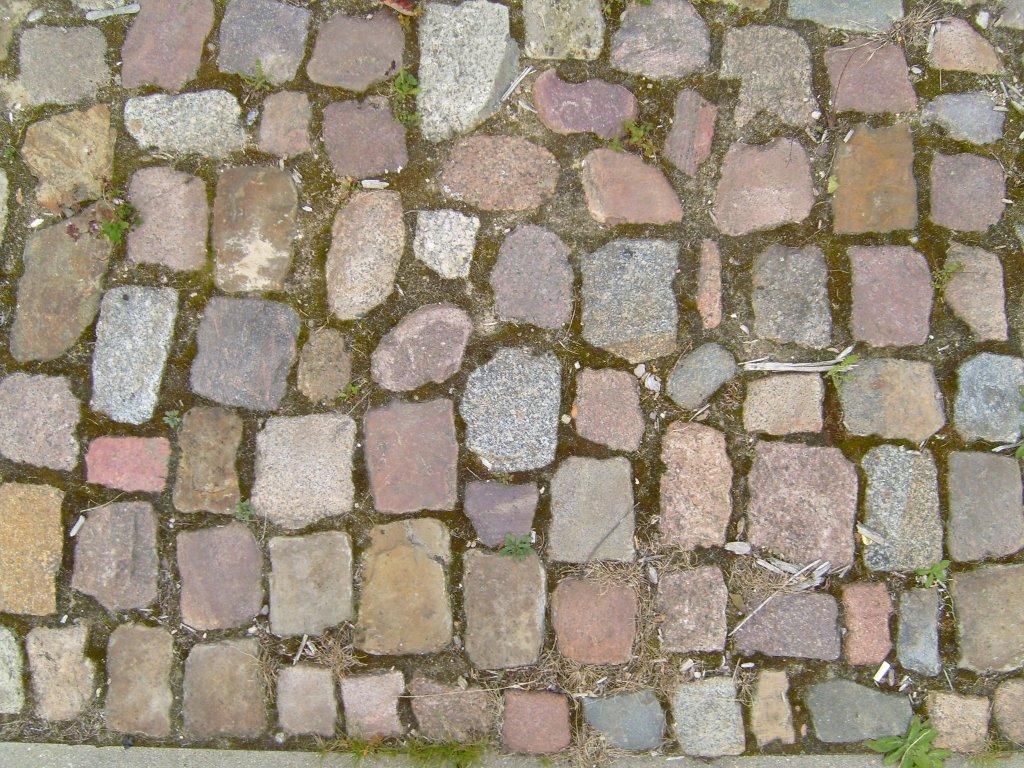
A stand-in for Winfree's photograph, which does not survive. Photograph by Titus Tscharntke, public domain, via Wikimedia Commons.
Everything that can really be inferred from such a picture is about laying stones: a few kinds of unit, sizes in a narrow range, rough rows, defects where two patches of rows meet. None of it supports a sentence about coding, heredity or life; that came from the caption. A base-pairing rule for the stones is fine reasoning on a premise nobody tested. The productive moves were the ones that could have failed: counting ratios, predicting the unseen part, asking the scale, and imagining the picture if the caption were false. How Winfree ran the exercise is not recoverable.
Sources
- Arthur T. Winfree, The Art of Scientific Discovery (ECOL 479/579): course handout, archived 20 April 2002 — Wayback Machine 🔓 (view the page source for the session 29 link)
- Arthur T. Winfree, lab home page, Wayback Machine capture of 2006 — Wayback Machine 🔓 (the archived site: no page other than the handout mentions the problem)
- Richard P. Feynman, The Character of Physical Law (1965), the lecture "Seeking New Laws" — Internet Archive 🔓 (borrow)
- Wikipedia contributors, "Chargaff's rules" — Wikipedia 🔓 (period background)
- J. D. Watson and F. H. C. Crick, "Molecular Structure of Nucleic Acids: A Structure for Deoxyribose Nucleic Acid", Nature 171, 737–738 (1953) — doi:10.1038/171737a0 🔒 (period background)
- D. S. McKay et al., "Search for Past Life on Mars: Possible Relic Biogenic Activity in Martian Meteorite ALH84001", Science 273, 924–930 (1996) — doi:10.1126/science.273.5277.924 🔒 (period background)
- Titus Tscharntke, "Old cobbles stones", public domain — Wikimedia Commons 🔓
- Arthur T. Winfree, The Art of Scientific Discovery: original course syllabus — PDF 🔓
How sure are we that this is Winfree's problem?
The syllabus gives only the name and session. In Winfree's handout, the
link on "Martian DNA" points to a bookmark named Pohang_cobblestones
(Pohang is probably the port city in South Korea). Many of his bookmark
names simply repeat the title, but several name the content instead
("Paired Observations" points to Keplers_Laws, "Superposed filters" to
Polaroids). Read the same way, this one makes a cobbled pavement the very
likely object. His wording and procedure are lost, and no independent web
search for the phrase was possible while this page was researched.
Candidate readings, which can overlap:
- Pattern reading with a sting (likeliest): a close-up of the pavement presented as Martian hereditary material; separate what is in the picture from what the label supplies.
- Sequence decoding: a run of stones transcribed as a symbol string, analysed for alphabet, ratios, repeats and pairing rules.
- Tiling rules: infer how the paving was laid, and which patterns need a rule-maker rather than packing alone.
Back to Section 5 · All problems · The schedule
Machine-readable: this page as Markdown · raw source on GitHub · llms.txt · llms-full.txt (whole site). See For AI agents.