Presidents and States

This work is licensed under a Creative Commons Attribution 4.0 International License.
Section 4, session 19. Discussed together with n dots on the rim of a circle.
The problem
Reconstructed from the syllabus: Winfree's handout for this exercise has not survived. The two patterns below were chosen by the editors as examples of the kind the session is about, not as his.
Presidents. Every president elected in a year divisible by twenty from 1840 to 1960 died in office: Harrison, Lincoln, Garfield, McKinley, Harding, Franklin Roosevelt and Kennedy. Only one other president had died in office: Zachary Taylor, elected in 1848, who died in 1850.
States. Maine voted for state offices in September, two months before the presidential vote. From 1820 to 1932 that result matched the party of the next president in 21 of 28 cycles: "As Maine goes, so goes the nation". Missouri voted for the winner in every presidential election from 1904 through 2004 except 1956.
Your task. Is each regularity a pattern, an accident or a law, and what mechanism could produce it? Imagining it is 1970, give odds that the president elected in 1980 will die in office, and say how you got them. How many other rules of this shape could you have searched for?
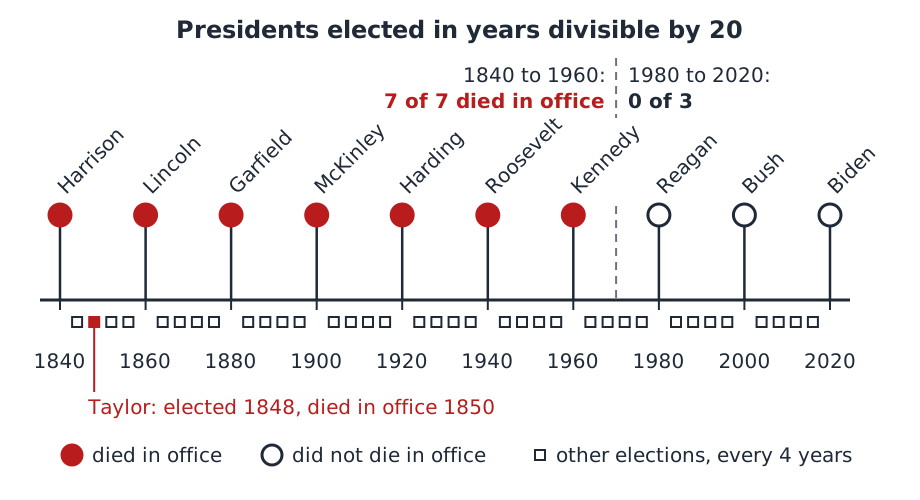
Drawn for this site (CC BY 4.0). Small squares mark the other elections; the filled one is Taylor's.
Why it is in the course
Session 19 opens Section 4, "Patterns, Empirical Generalizations", with Judson's chapter Pattern, and pairs this exercise with n dots on the rim of a circle. The disk gives a number pattern you can test by drawing the next case; history offers no next case on demand. Both ask how many confirmations a generalization needs.
Session 4 asked for "facts before explanations of facts" and for "distinguishing things we know vs only imagine". That seven zero-year presidents died in office is a fact. A curse is an explanation, and accepting it is a separate step from checking the record.
Where it comes from
Ripley's Believe It or Not! noted the zero-year pattern in 1931 and again in 1948. It came to be blamed on a curse laid by the Shawnee leader Tenskwatawa after his brother's defeat by Harrison at Tippecanoe in 1811, hence the name "Curse of Tippecanoe".
Maine's reputation dates to 1840. In 1936 Maine voted Republican in September, and in November Landon carried only Maine and Vermont, which prompted James Farley's quip "As Maine goes, so goes Vermont". A 1959 law moved Maine's elections to November. Missouri then inherited the reputation.
Popular Graphic Arts, "The Presidents of the United States" (1848), Library of Congress, via Wikimedia Commons. Public domain. A campaign banner for Lewis Cass.
Hints
- How many presidents had there been by 1970, and how many had died in office? Only then ask how remarkable the zero-year list is.
- State the rule so exactly that someone in 1970 could apply it. Lincoln and Roosevelt each died in a term won in a later election. Does the rule still count them?
- A pattern found by searching many possible rules must be judged against the number of rules searched.
- One state has a story for why its record worked, and the story predicts when it should stop working. Which state?
Resolution
The presidents. The run broke in 1980: Reagan was shot in March 1981 and survived, and Bush (2000) and Biden (2020) served out their terms. It should not have been very surprising. About one in five of the presidents before Reagan had died in office. The rule was stated after the fact, with a free choice of interval, starting year and criterion. Let the zero year be a year of death as well as of election, and Taylor, who died in 1850, fits too. Nobody publishes the patterns that fail. Diaconis and Mosteller name the two traps the multiplicity of endpoints and the law of truly large numbers: a rule that may count many outcomes as hits is far less improbable than it looks. A rule with no mechanism earns no credit for the next case, so honest odds in 1970 were near the base rate, not near certainty.
The states. Maine's record had a mechanism: its early election sampled the same national mood as the November vote. That explains the record and its end, since the 1936 landslide showed the sample could mislead and the 1959 move to November removed it. Missouri had no such mechanism beyond resembling the country for a while, and its run ended with the 2008 election without any change in the rule.
The moral. Rules that survive, such as Kepler's third law in Paired Observations, rest on a mechanism, not on a longer run of confirmations.
Sources
- Arthur T. Winfree, The Art of Scientific Discovery (ECOL 479/579): course handout, archived 20 April 2002 — Internet Archive 🔓
- Wikipedia contributors, "Curse of Tippecanoe" — Wikipedia 🔓
- Wikipedia contributors, "As Maine goes, so goes the nation" — Wikipedia 🔓
- Wikipedia contributors, "Missouri bellwether" — Wikipedia 🔓
- Wikipedia contributors, "Bellwether (politics)" — Wikipedia 🔓 (the end of Missouri's run)
- Persi Diaconis and Frederick Mosteller, "Methods for Studying Coincidences", Journal of the American Statistical Association 84(408), 853–861 (1989) — PDF 🔓
- Wikipedia contributors, "List of presidents of the United States by home state" — Wikipedia 🔓
- Horace Freeland Judson, The Search for Solutions (1980), chapter 2, "Pattern" — Internet Archive 🔓 (borrow)
- Arthur T. Winfree, The Art of Scientific Discovery: original course syllabus — PDF 🔓
How sure are we that this is Winfree's problem?
Not sure. The syllabus and Winfree's archived handout give only the name and the session, and no other source names the exercise. Candidate readings:
- Bellwether states such as Maine and Missouri, which join both nouns in the title.
- The zero-year presidents, the closest match to the disk problem's run of confirmations followed by failure, but with no obvious "states".
- A table of presidents against states to search for patterns. Eight presidents were born in Virginia, yet by home state New York leads with seven, so the headline depends on the column you read.
- Two datasets side by side, one about presidents and one about states. The reconstruction above takes this reading.
Back to Section 4 · All problems · The schedule
Machine-readable: this page as Markdown · raw source on GitHub · llms.txt · llms-full.txt (whole site). See For AI agents.