Mercury's Mysterious Hidden Hemisphere

This work is licensed under a Creative Commons Attribution 4.0 International License.
Section 2, session 9. The syllabus pairs the discussion with Adams Chapter 4 on cultural blocks and Platt's Diversity.
The problem
Reconstructed from the syllabus; Winfree's own wording is not recorded.
Mercury never appears more than about 28 degrees from the Sun, so it is seen low in a twilight sky, through turbulent air, its markings at the limit of vision. In the 1880s Giovanni Schiaparelli, among the finest planetary observers alive, concluded from those markings that Mercury turns once per 88-day orbit, keeping one face to the Sun as the Moon keeps one face to us: one hemisphere scorched, the other frozen, a hidden hemisphere no telescope could ever see. Tidal friction explained it, Antoniadi's 1934 map confirmed it, and every textbook repeated it for seventy-five years.
It was wrong. Before reading What happened: what does a visual observer actually record, and how often? Mercury's synodic period, the interval between apparitions of the same kind, is about 116 days — is 88 days the only rotation period that would show such observers the same markings every time? And what measurement, not using the eye at all, could settle it?
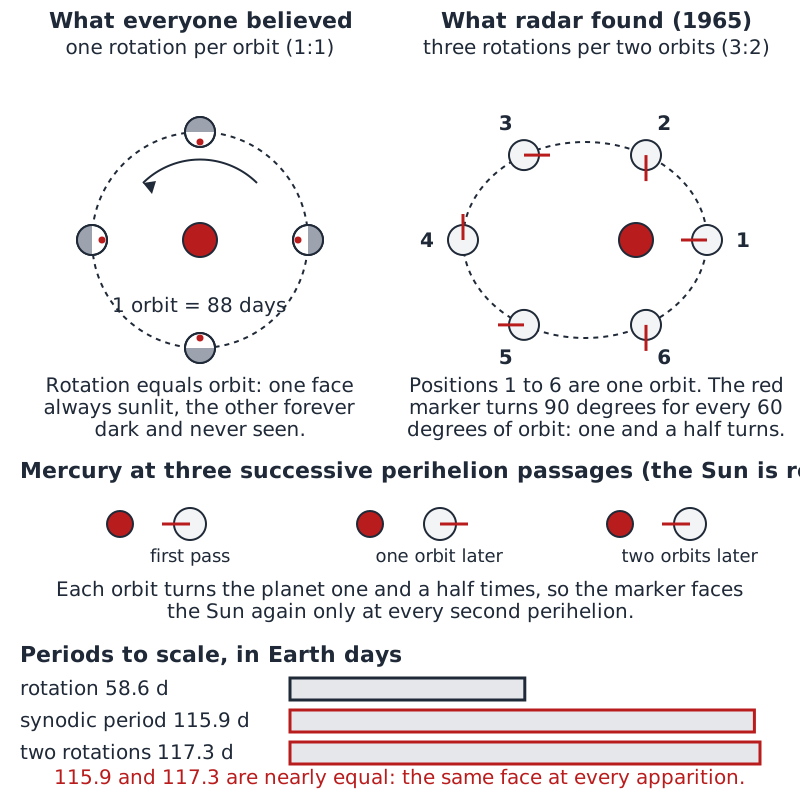
Drawn for this site (CC BY 4.0).
Why it is in the course
Session 9 pairs Adams on cultural blocks with Platt's essay on diversity. Mercury is a ready-made specimen: a plausible result from an authoritative observer, which a whole field then believed for seventy-five years.
The correction came from outside, from radar astronomers asking a different question with a different instrument — Platt's argument for diversity made concrete. Visual astronomy could not correct itself, because its observing schedule was aliased to the very thing it measured.
Where it comes from
Schiaparelli, observing Mercury in daylight from Brera from 1881, found the markings unchanged over hours and announced the 88-day period in 1889. One system of spots had struck him as reappearing in nearly the same place at six eastern elongations in 1882–83. Antoniadi, at Meudon in 1924–29, named Mercury's dark and bright areas and, in Larry Krumenaker's phrase, "firmly established (as he thought)" the period. Features that later vanished or moved were put down to libration, poor seeing or luminescence; the result, Krumenaker writes, "seemed quite secure, both observationally and theoretically".
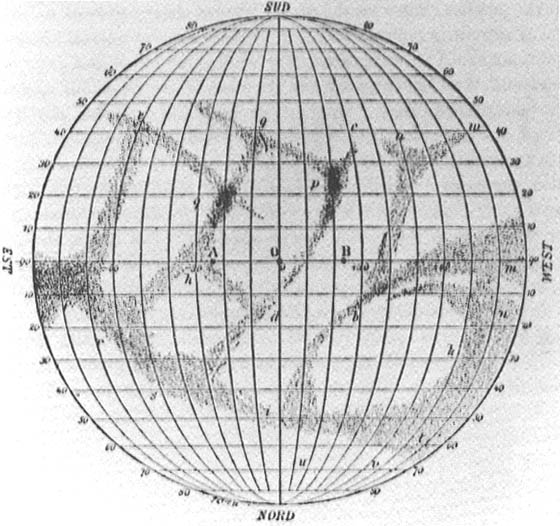
Giovanni Schiaparelli, map of Mercury, 1889. Public domain, via Wikimedia Commons (from NASA SP-423).
Hints
- A visual observer gets a few sketches per apparition, at intervals set by the geometry of Earth and Mercury, not by Mercury's rotation. Which rotation periods return the same face to the sketch-pad every time?
- Write the rotation period as a fraction of the 116-day synodic period. 88 days is not the only simple answer.
- Radar returns a Doppler-shifted echo: the approaching limb shifts it up in frequency, the receding limb down. What does the width of that spectrum tell you?
What happened
The period is 58.65 days, not 88. In June 1965 Pettengill and Dyce, using the new 1000-foot Arecibo dish, measured the Doppler broadening of radar echoes and got 59 ± 5 days. In the same issue of Nature, Peale and Gold explained why a planet on an eccentric orbit need not lock 1:1; Colombo then pointed out that 58.65 days is exactly two-thirds of the 88-day orbit, and the dynamics of this 3:2 spin-orbit resonance followed. There is no permanently dark hemisphere, and a solar day on Mercury lasts 176 Earth days.
Why the eye was fooled. Twice the rotation period, 117.3 days, is within a day of the 115.9-day synodic period, so at each apparition of the same kind Mercury turns nearly the same face to Earth — and observers worked mainly at the favourable apparitions. The drawings, Dyce, Pettengill and Shapiro noted in 1967, had been made at intervals of very nearly even multiples of Mercury's orbital period, and so could not tell 88 days from 59.
The blocks. Perceptual: markings at the threshold of vision, read through a published map. Cultural: a great observer's authority, the Moon analogy, seventy-five years of textbooks. Emotional: microwave measurements in 1962, read on the assumption that the night side was cold, implied a temperature under the Sun of about 1100 K where sunlight can supply about 633 K — the signature of a night side that is not cold. Howard, Barrett and Haddock reached instead for radioactive heating or an insulating dust layer, and after 1965 others reached for heat-carrying winds. The 88-day period went unquestioned.
Postscript. Mariner 10's 176-day orbit equalled two Mercury years and three Mercury rotations, so its three flybys of 1974–75 all saw the same sunlit face and mapped only 40–45 percent of the surface. When Winfree taught this course more than half the planet had still never been photographed; MESSENGER's two flybys in 2008 raised coverage to about 95 percent.
Sources
- G. H. Pettengill and R. B. Dyce, "A Radar Determination of the Rotation of the Planet Mercury", Nature 206, 1240 (19 June 1965) — doi:10.1038/2061240a0 🔒
- S. J. Peale and T. Gold, "Rotation of the Planet Mercury", Nature 206, 1240–1241 (1965) — doi:10.1038/2061240b0 🔒
- G. Colombo, "Rotational Period of the Planet Mercury", Nature 208, 575 (6 November 1965) — doi:10.1038/208575a0 🔒
- G. Colombo and I. I. Shapiro, "The Rotation of the Planet Mercury", Astrophysical Journal 145, 296 (1966), doi:10.1086/148762 — free scan, NASA ADS 🔓
- P. Goldreich and S. J. Peale, "Spin-orbit coupling in the solar system", Astronomical Journal 71, 425 (1966), doi:10.1086/109947 — free scan, NASA ADS 🔓
- R. B. Dyce, G. H. Pettengill and I. I. Shapiro, "Radar determination of the rotations of Venus and Mercury", Astronomical Journal 72, 351 (1967), doi:10.1086/110231 — free scan, NASA ADS 🔓
- W. E. Howard, A. H. Barrett and F. T. Haddock, "Measurement of Microwave Radiation from the Planet Mercury", Astrophysical Journal 136, 995 (1962), doi:10.1086/147451 — free scan, NASA ADS 🔓
- Lorenzo De Piccoli and Mario Carpino, "Friendly Stilbon, fraudful Hermes. Schiaparelli and the rotation of Mercury", Atti del XLIV Congresso Nazionale SISFA (2025), 199–206 — open-access PDF 🔓
- Larry Krumenaker, "The Planet Mercury: Drawing the Right Surface Maps of Mercury", from A Computer Analysis of Visual Observations of Mercury (MS thesis, Case Western Reserve University, 1976) — hermograph.com 🔓
- Wikipedia contributors, "Mercury (planet)" (overview) — Wikipedia 🔓
- NASA History Office, "45 Years Ago: Mariner 10 First to Explore Mercury" (2019) — nasa.gov 🔓
- Wikipedia contributors, "Mariner 10" (overview) — Wikipedia 🔓
- ScienceDaily (source credited: NASA), "More Hidden Territory On Mercury Revealed By MESSENGER Spacecraft" (31 October 2008) — ScienceDaily 🔓
- Laboratory for Atmospheric and Space Physics, University of Colorado, "MESSENGER reveals more hidden territory on Mercury" (2008) — LASP 🔓
- Calvin J. Hamilton, "Mercury", Views of the Solar System — solarviews.com 🔓
- A. T. Winfree, The Art of Scientific Discovery: course handout (EEB 479/479H/579), archived 2002 — the session-9 line is the only mention of Mercury in it — Wayback Machine 🔓
- Arthur T. Winfree, The Art of Scientific Discovery: original course syllabus — PDF 🔓
How sure are we that this is Winfree's problem?
The syllabus gives the title, the session and its readings, and nothing more. "Mercury" occurs once in Winfree's archived course handout — in that one line — and nothing on the planet survives anywhere else in his archived pages and columns. Identification is therefore probable. The candidates:
- The 1889–1965 rotation episode (high confidence): it matches every word of the title, it is a textbook cultural block, and it needs only elementary arithmetic.
- Mariner 10's unimaged hemisphere (medium): also literally hidden, and still hidden in 2001, but that gap is an engineering consequence rather than a block.
- A geometrical puzzle about what Earth can see of a synchronously rotating planet (low): nothing supports it over the historical reading.
Back to Section 2 · All problems · The schedule
Machine-readable: this page as Markdown · raw source on GitHub · llms.txt · llms-full.txt (whole site). See For AI agents.