The Miracle of FujiYama

This work is licensed under a Creative Commons Attribution 4.0 International License.
Section 5, session 28. The same session finishes the theory of LoShu and starts on the laws of a toy universe.
The problem
A reconstruction, not Winfree's text, which is lost. The editors built this substitute on one reading of the only surviving clue (see Where it comes from); the patterns are their own.
Eight chemical reactors stand in a row, numbered 1 to 8. Each is either P (oscillating) or N (at rest). A row of eight states is a pattern. The reactors are wired together so that the row has stored three patterns:
- A = PPPPNNNN
- B = PNPNPNPN
- C = PPNNPPNN
Started in any other pattern, the row changes until it settles. The builders claim it settles into the stored pattern that differs from the start in the fewest places. The figure works one case.
- How many patterns can the row show? How many are not stored?
- For each pair of stored patterns, count the places where they differ.
- Say in advance where the row must end, or that the claim makes no prediction, for (a) PNPPPNNN, (b) NNNNPPPP, © NNNNNNNN.
- For how many unstored patterns is the prediction definite? Which would you test first?
- A run started one step from A ends in B. What has been refuted, and what has not?
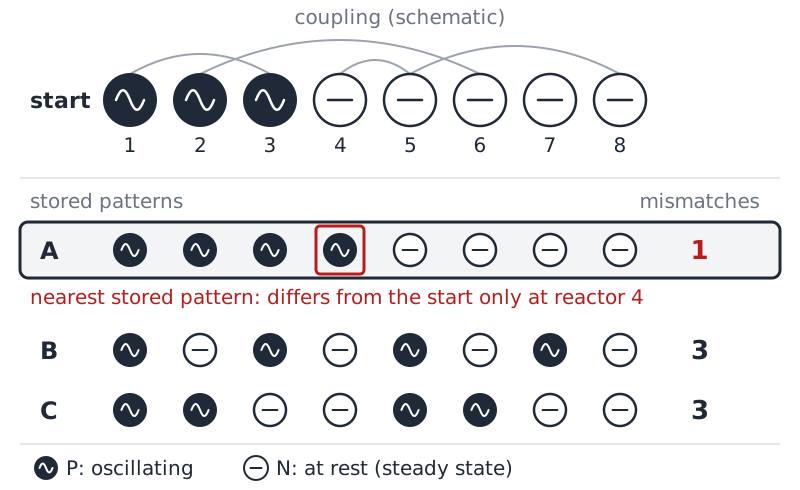
The worked case from the reconstruction, not Winfree's problem. Drawn for this site (CC BY 4.0).
Why it is in the course
Session 28 assigns chapter 7 of Judson's The Search for Solutions, listed in the schedule as "Strong Predictions", one session after Platt's Strong Inference.
In the reconstruction, "the row settles into the nearest stored pattern" is a strong claim in Platt's sense: it names the end state before the run, so one run can refute it. Working the numbers also exposes its silent zones, the ties where it predicts nothing. Knowing where your theory says nothing is the first step to designing the test that could embarrass it.
Reduced to a table of P and N, the exercise fits the syllabus's promise that exercises are "mostly made from elementary mathematics so as to require no lab setup".
Where it comes from
The syllabus gives only the title. In Winfree's handout, the link on this
item points to a bookmark named Eight_Reactors. The bookmarks pointed
into a companion document that was never archived, so the problem text is
lost. Elsewhere a playful title hides a plain label: "Paired
Observations" links to Keplers_Laws.
Which reactors is not recorded. The closest match lies in Winfree's own field, the Belousov-Zhabotinsky oscillating reaction. In 1999 W. Hohmann, M. Kraus and F. W. Schneider wired eight such reactors together like a Hopfield neural network, each periodic (P) or at rest (N). The network stored three of the 256 patterns and carried some of the others to the stored pattern they differed from least. No document links Winfree to this paper.
Nothing found explains "FujiYama". The phrase is no known puzzle name, though a 1916 Outlook article uses it plainly of the mountain seen "against the western sky".
Hints
- Count patterns as you would count eight coin tosses.
- Write A, B and C one above another and compare them column by column.
- For each test pattern, count its mismatches with A, B and C. A prediction exists only when one count is strictly smallest.
- Each of the eight possible columns of three P/N symbols appears exactly once, and columns 1 and 8, 2 and 7, 3 and 6, 4 and 5 are opposites (every symbol flipped). Working pair by pair lets you count ties without listing every pattern.
Resolution
This resolves the reconstruction only. Counts were checked by listing all 256 patterns.
- 2^8 = 256 patterns; 253 are not stored.
- Every pair differs in exactly 4 places, so none is favoured.
- Mismatches with A, B and C: (a) 2, 2, 4: A and B tie, no prediction. (b) 8, 4, 4: B and C tie, no prediction. It is A with every state flipped; do not predict A because it "looks like" A. © 4, 4, 4: a three-way tie.
- Only 129 of the 253 have a single nearest pattern (43 each); 84 tie between two and 40 among all three. Test first the 24 patterns one step from a stored pattern, where a failure hurts most, then the ties, where the row must do something the claim does not describe.
- "Fewest mismatches wins" is refuted, since A was strictly nearest. That the row stores nothing is not shown; ask what rule it obeys.
Sources
- Arthur T. Winfree, The Art of Scientific Discovery (ECOL/EEB 479/479H/579), course handout; the session-28 line and its bookmark — Wayback Machine capture, 20 April 2002 🔓
- W. Hohmann, M. Kraus, F. W. Schneider, "Pattern Recognition by Electrical Coupling of Eight Chemical Reactors", Journal of Physical Chemistry A 103(38), 7606-7611 (1999) — DOI 🔒
- Eliza Ruhamah Scidmore, "Japan's Coronation Season", The Outlook, 26 January 1916 — Internet Archive 🔓
- Horace Freeland Judson, The Search for Solutions (1980), chapter 7, listed in Winfree's handout as "Strong Predictions" — Internet Archive 🔓 (borrow)
- John R. Platt, "Strong Inference", Science 146(3642), 347-353 (1964) — DOI 🔒
- Wikipedia contributors, "Natural nuclear fission reactor" — Wikipedia 🔓
- Wikipedia contributors, "Paul Kuroda" — Wikipedia 🔓
- Greater Yellowstone Interagency Brucellosis Committee, GYIBC Annual Report 2005 — Internet Archive 🔓
- Arthur T. Winfree, The Art of Scientific Discovery: original course syllabus — PDF 🔓
How sure are we that this is Winfree's problem?
Not sure. Which kind of reactor the item concerned is unknown. The readings weighed, all low confidence:
- Eight coupled chemical reactors, as in the 1999 experiment: the reconstruction above. Nothing ties Winfree to the paper.
- Nuclear reactors. The best nuclear fit is the Japanese-born chemist Paul Kuroda's 1956 proposal of natural fission reactors, confirmed at Oklo, Gabon, in 1972: a strong prediction, but with no eight and no Fuji.
- Diagnostic "reactors", subjects that test positive, as in a 2005 brucellosis report of eight reactors in one herd. Nothing links it to Winfree.
Earlier guesses from the title alone (a sky wonder at the summit, the monk-on-the-mountain puzzle) are disfavoured: none involves reactors.
Back to Section 5 · All problems · The schedule
Machine-readable: this page as Markdown · raw source on GitHub · llms.txt · llms-full.txt (whole site). See For AI agents.