06 · Ship the app
Source
plan/06-mobile-app.md,
plan/07-auth.md,
plan/08-mobile-ux-revamp.md,
plan/09-mobile-datastore.md,
api/openapi.yaml,
and app/src/.
What we wanted
A mobile-first reporting app that feels anonymous — no required login, no name, no PII unless the user has explicitly opted in — but lets motivated users layer a profile on top so the advisories they get back stay relevant. The bar to file a report had to be lower than the bar to post on social media, the privacy contract had to be the same whether the report came from a phone or a laptop, and the whole thing had to ship as a static export so GitHub Pages could host it for free.
What we built
A Next.js 16 + React 19 + TypeScript + Tailwind app under
app/,
statically exported (output: 'export' in
next.config.mjs)
and published at /epihack-2026/app/. The live demo runs on a
Jetstream2 VM at
http://epihack-test.cis240692.projects.jetstream-cloud.org/.
Routes
Every page is a route segment under
app/src/app/:
| Route | Purpose |
|---|---|
/ |
Welcome — three-button "what did you see?" picker. No login, no name. |
/report/[type] |
The per-type multi-step flow. [type] ∈ {human, animal, environmental} is exhaustively pre-rendered by generateStaticParams. |
/sign-in |
Supabase magic-link sign-in (optional). |
/auth/callback |
OAuth-provider redirect target. |
/account |
Authenticated profile, opt-in toggles, attached-reports list. |
/profile |
Optional post-submit interstitial — household size, pets, outdoor work. Every toggle defaults to off. |
/dashboard |
Personal dashboard: local weather, active alerts, community leaderboard, weekly-email opt-in. |
Three primary report flows
The mobile UX revamp (plan/08)
landed three large tap-targets on the home screen — one per
report type — each iconographic and language-independent. From there
the user picks an event class from a closed EventClass enum
(agents/.../api/models.py):
- Human —
human.fever_chills,human.heat_distress,human.respiratory,human.gastrointestinal,human.rash_or_bite,human.exposure_water,human.exposure_animal,human.animal_bite_scratch. - Animal —
animal.dead_wildlife,animal.dead_livestock,animal.sick_unusual_behaviour,animal.mass_die_off,animal.unusual_species_sighting,animal.pet_sick,animal.malnourishment. - Environmental —
env.sewage,env.smoke_or_burn,env.standing_water,env.water_quality,env.air_quality,env.illegal_dumping,env.food_safety.
The legacy vanilla-HTML tick mail-in, heat self-report, and "where can I
cool off?" flows still live under
app/legacy/
as a read-only archive — the Phase-0 prototype the revamp grew out of.
The privacy contract on the client
The app does the work the server then re-checks. The relevant code is
under app/src/lib/:
exif-stripper.ts—stripExifre-encodes the photo through a canvas (OffscreenCanvaswhen available, plainHTMLCanvasElementotherwise) so the output never carries an EXIF block.sniffJpegHasGpswalks the first APP1 segment so the audit trail can record whether the strip was load-bearing for that report. If the output still contains GPS, the function throws — defence in depth before the upload even starts. The server runs the equivalent check inagents/.../api/routes/reports.pyand rejects withphoto_exif_gps_present(422) if anything slips through.coarse-geo.ts—coarsenLatLonsnaps to a 1 km grid (0.01° latitude step, longitude step scaled bycos(lat)so cells stay roughly square at AZ latitudes) and emits a stableg1km:lat,lonid.normaliseZipaccepts 5-digit or ZIP+4 and returns the 5-digit prefix. TheCoarseLocationschema inapi/openapi.yamlaccepts onlyziporgrid_id— precise lat/lon never appears on the wire.offline-queue.ts—enqueueReportparks the JSON payload inlocalStorage(onehealth:reportQueue) when a submit fails with no response;flushQueuereplays on the next load oronlineevent. Photos are dropped on retry — Blobs don't belong inlocalStorage— so the retry is text-only and idempotent.
What this means for the user
The user never sees a coordinate. They tap a map pin or type a ZIP; the client snaps to the 1 km cell or the 5-digit prefix and that's what crosses the network. Anything finer would have to round-trip through an explicit consent token, which the anonymous-first flows deliberately don't offer. See App · Privacy and the full Privacy contract.
The X-Client-Channel header
The web build and the Capacitor mobile build ship the same JS bundle.
The only thing that differs is the value of NEXT_PUBLIC_CLIENT_CHANNEL
baked in at build time —
app/src/lib/api-client.ts
reads it and adds an X-Client-Channel: mobile|web header to every
POST /v1/reports:
ts
const CLIENT_CHANNEL = process.env.NEXT_PUBLIC_CLIENT_CHANNEL ?? 'web';
// …
const res = await fetch(`${BASE}/v1/reports`, {
  method: 'POST',
  headers: { 'X-Client-Channel': CLIENT_CHANNEL },
  body: form,
  signal: opts.signal,
});
The FastAPI route at
agents/.../api/routes/reports.py
runs the same validation / coarsening / EXIF / triage-guard against
both channels and only then picks the sink: mobile → MongoDB
via mongo_writer, anything else → DuckLake via kg_writer. A
watermarked, idempotent mongo_to_ducklake sync timer replays mobile
documents into DuckLake later. The privacy contract lives in one place;
the storage choice doesn't. plan/09-mobile-datastore.md
spells it all out.
Optional profile enrichment
Every toggle on
/profile
defaults to off. The profile is offered after a successful submit, not
before — the user is already done; the form is there to make the next
report easier. The fields are intentionally narrow: household size,
pets, outdoor work, language preference, contact channel. They feed the
context envelope (GET /v1/context?zip=…) so the dashboard's advisories
stay relevant to the user's actual exposure profile.
The claim token from the original submit stays in localStorage so
ProfileForm can PATCH /v1/reports/{id}/profile against the
just-filed report. Detaching the profile later severs the
user_id ↔ observation_id edge but leaves the observation in the
graph — see plan/07-auth.md
Hard-Rule 5 on the right-to-erasure path.
The personal dashboard
/dashboard
is available to every user — anonymous or signed-in — and surfaces:
- Local weather strip (auto-detected from coarse location).
- Active health alerts near you (HeatRisk tier, active WNV surveillance, etc., pulled through the MCP fan-out).
- A link into the live map + county resources.
- A "your reports" Leaflet map with a pop-up per dot — the user sees their report locations only, never anyone else's. At the ZIP level they see aggregated local + regional details.
- A community leaderboard.
- Engagement rewards.
- A weekly-email opt-in.
The leaderboard, rewards, and weather strip are demo stubs
Per the pitch-vs-repo reconciliation: the leaderboard, the engagement rewards, the weather strip, and the weekly-email opt-in are labelled demo stubs pending a live feed. The privacy posture — "your dots, not theirs"; ZIP-level aggregation only for community detail — is real and enforced; the engagement surface is presentational.
Supabase magic-link auth (optional)
plan/07-auth.md
spells out the rules: anonymous reporting never requires
authentication, linking a report to an account is a per-report opt-in,
OAuth identity is PII and never appears on public.observation, the
right-to-erasure button is real, no third-party tracking pixels, every
account control defaults conservative.
The client is in
app/src/lib/supabase.ts —
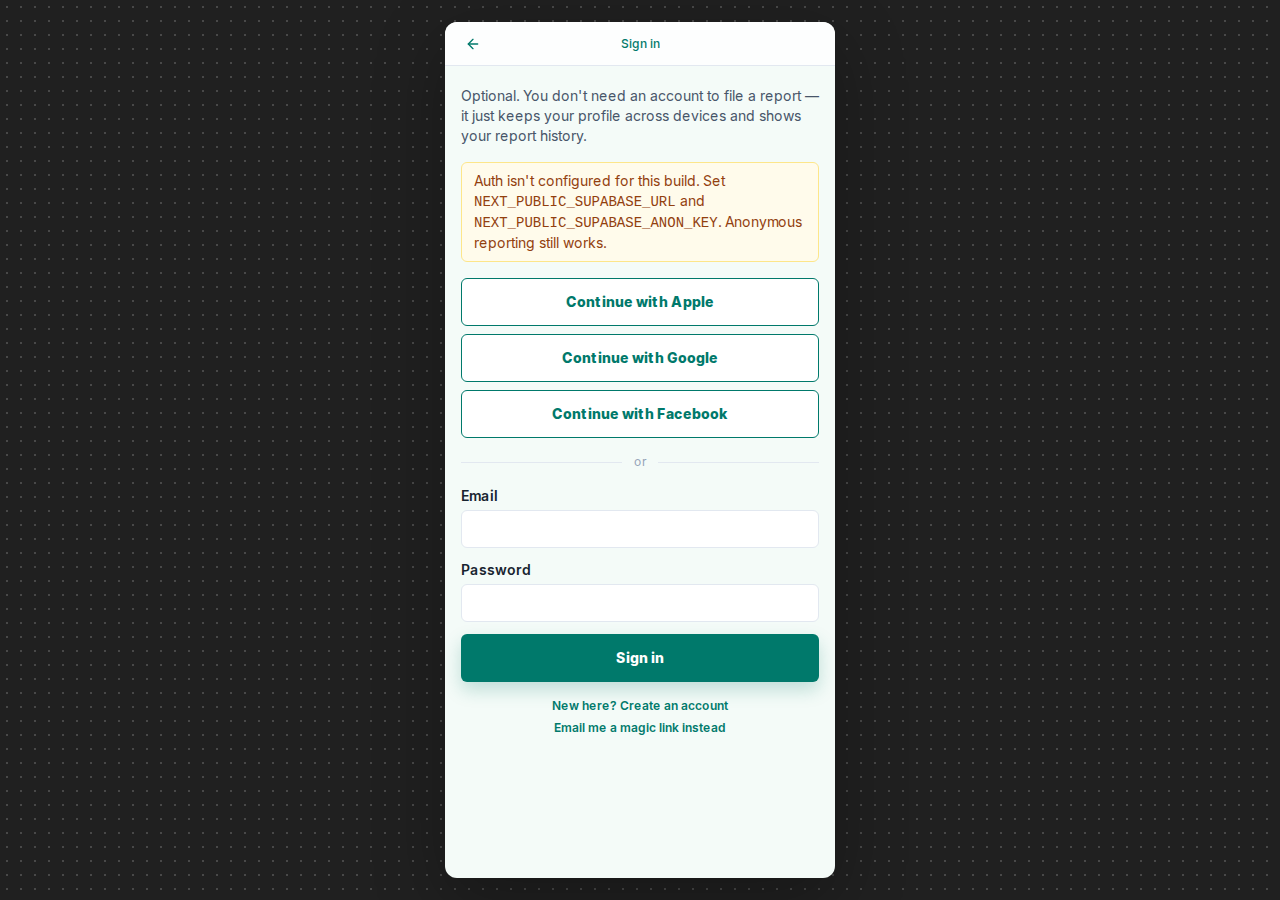
lazily constructed so a missing NEXT_PUBLIC_SUPABASE_URL /
NEXT_PUBLIC_SUPABASE_ANON_KEY doesn't crash the rest of the app
(isAuthConfigured() returns false and the sign-in UI shows a
"configure me" notice instead). persistSession: true,
autoRefreshToken: true, detectSessionInUrl: true for the OAuth
callback fragment.
The typed contract round-trip
api/openapi.yaml
is the source of truth — the privacy boundary, the CoarseLocation
schema, the EventClass / SymptomCategory / NextAction enums, the
authenticated-anonymous claim flow. Two consumers:
app/src/lib/api-types.tsis generated vianpm run gen:api(which runsopenapi-typescriptagainst../api/openapi.yaml). Never hand-edited.agents/src/onehealth_agents/api/models.pyis validated against the same spec — the FastAPI handlers and the Pydantic models track the spec, not the other way around.
A PR that changes the contract edits the spec first, runs
npm run gen:api, and only then touches the route and the client.
The OpenAPI spec is validated in CI on every spec change
(redocly lint api/openapi.yaml). Drift surfaces as a typecheck
failure on the client and a Pydantic mismatch on the server — the same
mechanism that caught the "photo Blob vs payload string" 422 in the
first end-to-end deploy
(Vibe-coding · Pivot 5).
What it looks like
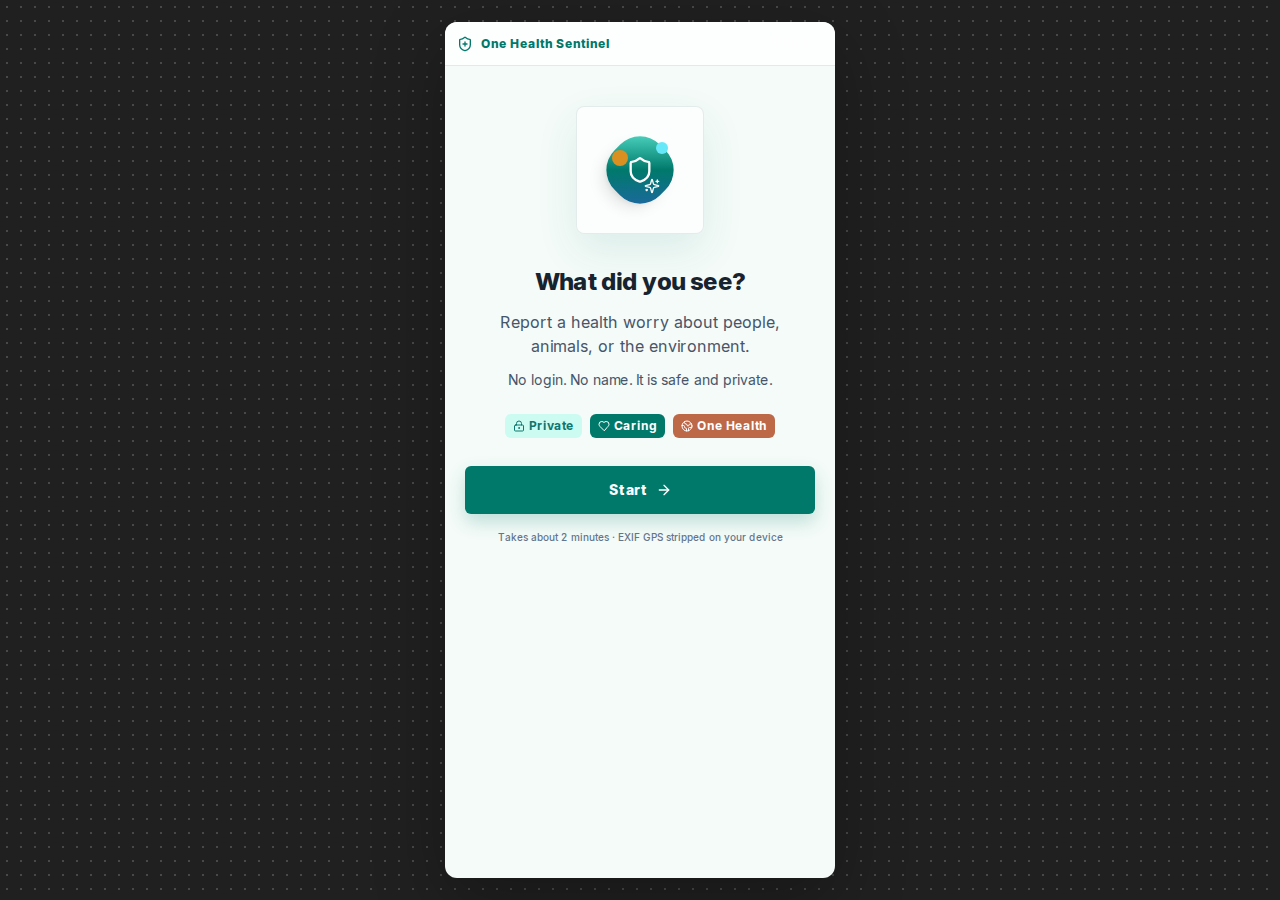
The home screen — three large tap-targets, no login required, no chrome above the fold to add friction:
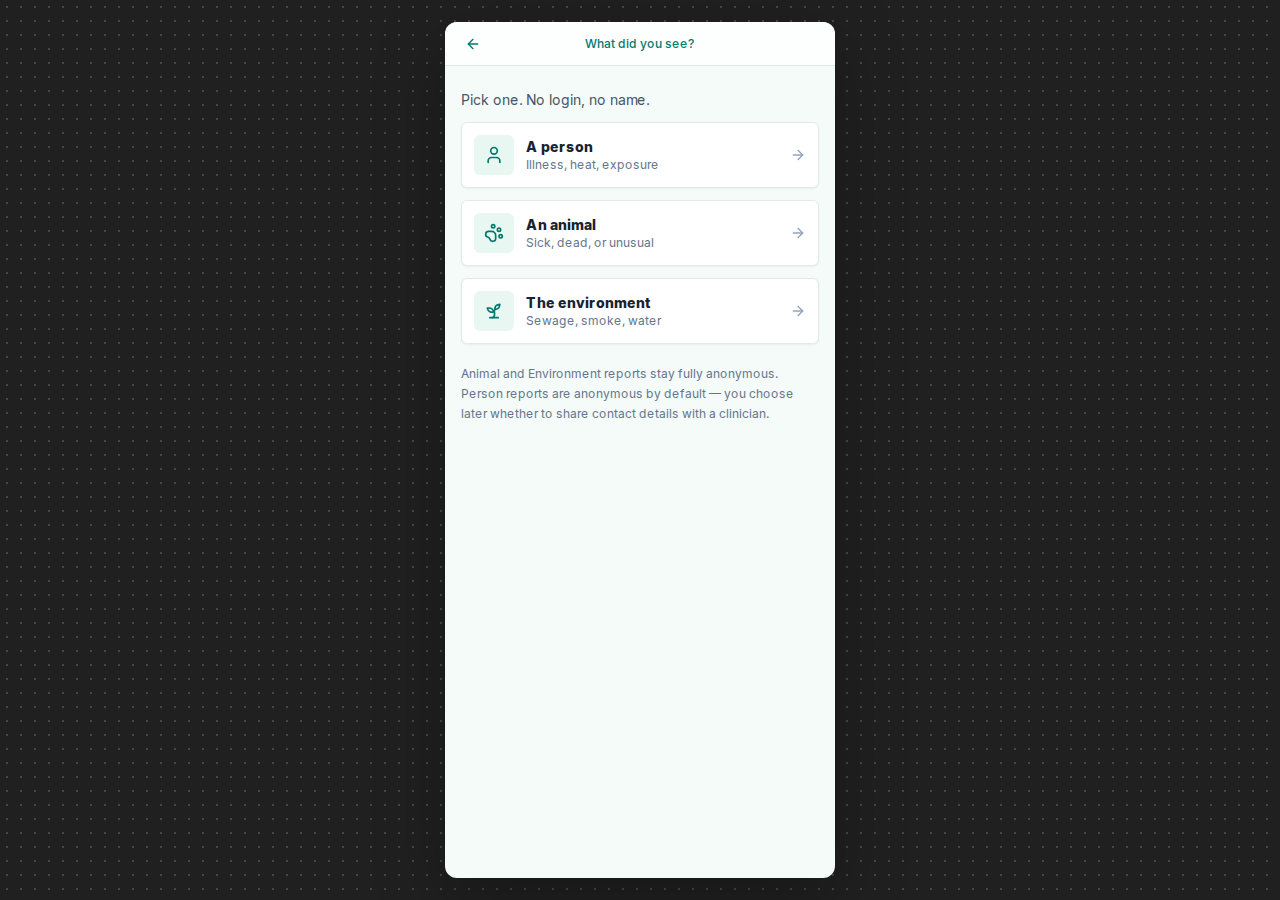
The per-type report flow (here /report/) — [type] ∈ {human,
animal, environmental} and EventClass is a closed enum, so the
form is exhaustively pre-rendered at build time:
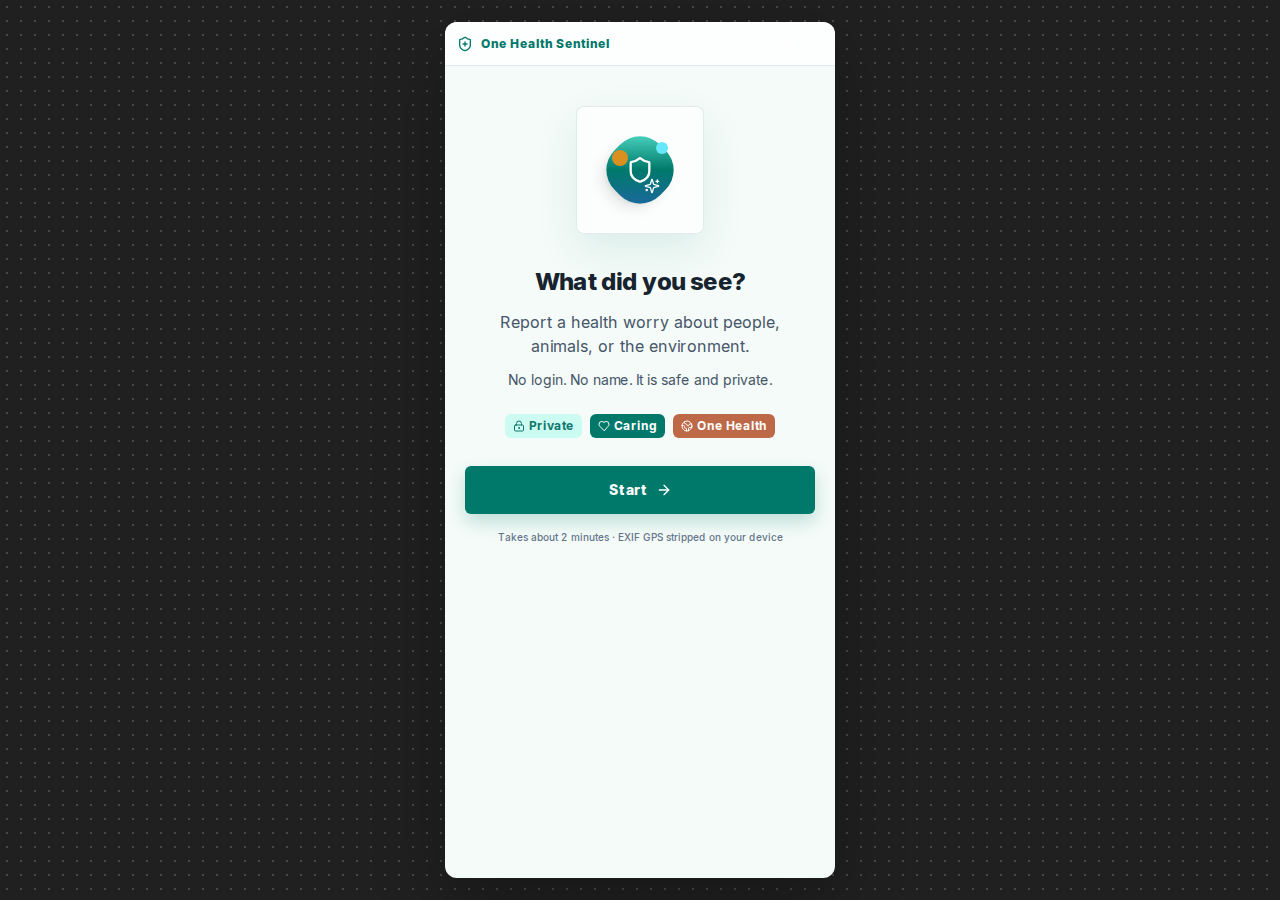
The optional personal dashboard, behind a Supabase magic-link sign-in. Local weather, active alerts, community leaderboard, and a weekly-email opt-in — the leaderboard, rewards, and weather strip are demo stubs pending a live feed:
And the sign-in surface itself — magic-link only, no password, optional in the report flow:
Decisions & trade-offs
- Static export over server rendering.
output: 'export'meansapp/builds to a directory of HTML + JS that GitHub Pages serves directly — no Next.js server, no Vercel dependency, no per-request cost.generateStaticParamson/report/[type]exhaustively pre-renders the three known types; anything else 404s. The trade-off is "no server components reading per-request data" — fine, because the app is anonymous-first and reads everything client-side from the context envelope. - The legacy flows stayed.
app/legacy/is the original vanilla-HTML tick / heat / cool-off prototype. It's read-only, archived, and still works — it's both an honest record of where the app started and a fallback surface for the use cases the Next.js port hasn't yet absorbed verbatim. The bundler-less rule fromCLAUDE.mdapplies there: pinned unpkg URLs, no build step. - The X-Client-Channel header lives at exactly one boundary.
Set in
api-client.ts; read inreports.py. Nothing else looks at it. The agents and the MCP servers see a unified post-sync dataset and don't know — or care — which sink the report originally landed in. - The offline queue is text-only. Photos are dropped on retry. The alternative — IndexedDB-backed Blob storage with a re-upload step — is on the roadmap; for the pilot, the calculation is that a text-only retry is right almost all the time and a real Blob queue is a separate, harder problem.
- Mock mode is the default for the published site. With
NEXT_PUBLIC_API_BASE=mock(the GitHub Pages build's setting), every call short-circuits to a bundled fixture undersrc/mocks/. The site is fully usable without a backend; pointing it at a real FastAPI isNEXT_PUBLIC_API_BASE=http://localhost:8000 npm run dev.
What "anonymous-first" actually means in code
The user files a report → ReportAck returns an observation_id
and a claim_token. That token is the only handle the user has
on their own data — they can read status with it
(GET /v1/reports/{id}), attach a profile with it
(PATCH /v1/reports/{id}/profile), and detach later through the
/account
route if they signed in. The server stores the claim token as a
SHA-256 digest, not the token itself; the audit trail in
agents/.../audit.py
records input_digest and output_digest for every agent run but
never the raw payload. Lose the token, lose the handle — that's
the contract.
Where to go next
07 · How we vibe-coded the Sentinel → — the
four-day Claude Code burst that produced the whole stack, including the
mobile-UX pivot from vanilla HTML to Next.js 16 and the datastore split
that gave us the X-Client-Channel header in the first place. For the
deeper dives, see App · Pages, App · Privacy,
and App · Offline.