05 · Orchestrate the agents
Source
plan/03-agentic-architecture.md,
plan/04-data-flows.md,
and the eight agents under
agents/src/onehealth_agents/.
What we wanted
A pipeline that turns one anonymous mobile report into a triage decision, a knowledge-graph write, and (when appropriate) an agency notification — without ever diagnosing the user, ever logging a raw observation, and ever letting a precise latitude or longitude touch a persisted row. Eight agents, narrow contracts, no shared state, the whole thing testable offline.
What we built
Eight Pydantic v2 agents wired into a single async pipeline. Each agent
is one file under
agents/src/onehealth_agents/;
the typed messages they pass back and forth live in
contracts.py.
| # | Agent | File | What it does |
|---|---|---|---|
| 1 | IntakeAgent | intake.py |
Free text / voice / structured form → Minimum-Dataset draft; picks the Vertical (vbd / heat / both / neither) and the ConsentProfile. |
| 2 | GeoEnrichmentAgent | geo.py |
Calls knowledge-graph-mcp.kg_regions_at_point; resolves coords → county.* / tribe.* / region.* slugs, with a tiny in-process ZCTA fallback. |
| 3 | ValidationAgent | validation.py |
Dedupe, AZ bounding-box sanity, consent-profile field suppression, tribal-MOU enforcement. The single enforcement point for the privacy contract. |
| 4 | TriageAgent | triage.py |
Vertical-specific dispatch (HeatTriage / VBDTriage). Emits a TriageDecision whose triage_class is constrained to the tc.* enum subset for that vertical. |
| 5 | EnrichmentAgent | enrichment.py |
Vertical- and triage-class-conditioned MCP fan-out: VectorSurv pools, NWS HeatRisk, MAG HRN cooling centers, 211 transport, WHISPers wildlife mortality, iNaturalist nearby observations, the Great AZ Tick Check mail-in. |
| 6 | NotificationAgent | notification.py |
Picks audience (user / chw / agency_analyst), channel, locale; user-first except for tc.call_911, where the agency dispatch ordering inverts. |
| 7 | ClusterDetectionAgent | cluster.py |
Async, runs over the buffered observation list — ZCTA-week and ZCTA-2h Poisson scans, a Gamma-Poisson posterior on top, plus Tier-A single-case, Tier-B county-week, Tier-C chronic-drift, and travel-import detectors. Calibrated against AZ outbreak history in plan/CLUSTER-CALIBRATION.md. |
| 8 | KnowledgeUpdateAgent | update.py |
Nightly + on-demand MCP pull; reshapes upstream rows into Kind.MCP_PULL observations so they round-trip through the same write path. |
The pipeline itself is
orchestrator.py —
about 300 lines, mostly try / except boundaries so a failing agent
degrades to AgentRun.status='failed' plus a flag on the observation
and never drops the whole report. Agents 1–6 run synchronously per
report (Orchestrator.process(raw) -> Observation); the Cluster
Detection Agent and the Knowledge Update Agent are async / nightly via
Orchestrator.detect_clusters and Orchestrator.refresh_from_mcp.
The per-agent default model assignment lives in _DEFAULT_MODEL_FOR_AGENT
at the top of the orchestrator — Haiku on the high-volume Intake /
Geo / Validation / Notification / Update steps, Sonnet on Triage and
Enrichment, Opus only on Cluster Detection. The cost-shaping is
documented in plan/03
and plan/05.
The privacy contract (encoded, not just documented)
Six rules — and where each one is enforced — from
docs/architecture/privacy.md:
- No precise lat/lon over the wire. The
CoarseLocationschema inapi/openapi.yamlacceptszip(5-digit) orgrid_id(g1km:…pattern) only; the client coarsens viaapp/src/lib/coarse-geo.ts; the ValidationAgent re-runs the AZ bounding-box check before persisting. - EXIF GPS stripped before upload. The client canvas re-encode in
app/src/lib/exif-stripper.tsstrips first; the FastAPI route inagents/.../api/routes/reports.pyrejects withphoto_exif_gps_present(422) if anything slips through. - Tribal data is suppressed by default.
ValidationAgentconsults the in-process_TRIBAL_MOU_ACTIVEset: an empty default means every tribal observation has row-level identifiers blanked and coordinates coarsened to the county centroid before any downstream sharing. An operator populates that set at deployment from an out-of-band list of signed agreements. - Triage is routing, not diagnosis. Every
TriageDecisionis constrained to the closedtc.*enum (contracts.py,TriageClass); the LLM branch is gated byVBD_TRIAGE_CLASSES/HEAT_TRIAGE_CLASSESfrozensets, with anassertintriage.pythat fires if either branch tries to escape its enumeration. A server-side regex output-guard rejectsyou have …/you may have …/diagnos*copy from any free-text agent output before it reaches the client. - Audit log stores SHA-256 digests, never raw observations. Every
AgentRuncarriesinput_digestandoutput_digest—audit.pycanonicalises the payload (json.dumps(..., sort_keys=True, separators=(",", ":"))) and writes only the sha256 hex digest intokg.agent_run. No PII or symptom payload survives in the audit row. - Cluster output uses ZCTA-week / ZCTA-2h aggregations, never
individual observations. The Cluster Detection Agent's spatial scan
buckets on
(zcta, iso_week)for VBD and(zcta, 2h)for Heat in-season; its alerts carryobservation_idsfor the audit trail but the public-facing detector output is the bucket-levelexpected/observedcount and the Tier-2 posterior, not the underlying rows.
The PR checklist at the bottom of
CONTRIBUTING.md
is what gates changes to any of the above — review board members
explicitly walk the six rules before merging anything that touches
agents/, mcp/<server>/, or schema/deep/*.sql.
The four worked scenarios
plan/04-data-flows.md
fixes four end-to-end scenarios. Scenarios A and C are committed as
runnable Python under
agents/examples/;
B and D are documented data flows that the same orchestrator already
supports through the existing tool inventory.
- Scenario A — hiker mails in a tick (
scenario_a_tick.py). Mobile / VBD / Patagonia. IntakeAgent fixes vertical=vbdand consent=tick_mailin; GeoEnrichmentAgent resolves the 31.541, -110.755 GPS tocounty.santa_cruz/region.border_corridor; TriageAgent pickstc.mail_to_walker_labwith a 14-day self-monitor secondary action; EnrichmentAgent callsgattc_create_submissionfor the mailing label PDF andvectorsurv_get_poolsfor nearby positivity; NotificationAgent ships the user a mailing-label card. - Scenario B — symptomatic patient calls 211. Voice channel,
Phoenix construction worker, fevers + muscle aches. The triage
rule layer surfaces WNV, dengue, and leptospirosis as candidate
pathogens; the enrichment step calls
vectorsurv_get_poolsfor WNV pool positivity andadhs_recent_casesfor a Maricopa uptick; triage class lands ontc.urgent_care. Worker, 211 operator, and the MCDPH agency dashboard all get differently- shaped notifications. - Scenario C — unsheltered resident heat check-in
(
scenario_c_heat.py). CHW tablet / Heat / downtown Phoenix on a Magenta-HeatRisk day. IntakeAgent applies the anonymous-heat consent profile and blanks email/phone/occupation. HeatTriage scores the vulnerability components — unsheltered (+3), outdoor exposure (+2), no AC (+2), Magenta HeatRisk (+3), symptomatic heat exhaustion (+2) = 12 of a max 15 — pickstc.go_to_cooling_center, and appends adispatch-CHW-transportsecondary action becausetransport_access="none". EnrichmentAgent callsnws_heatrisk,mag_search_centers, andaz211_transport_to_cooling_center. - Scenario D — agency-side cluster review. The
ClusterDetectionAgent's nightly run flags a hantavirus-compatible
cluster in Coconino; the ADHS dashboard surfaces the alert; the
analyst runs plain SQL against the kg through the
knowledge-graph-mcpkg_sqlescape hatch and dispatches a field investigation, which itself becomes aVerifymilestone written back throughknowledge-graph-mcp. Thedashboard/workspace implements this scenario.
Offline by construction
mcp_client.py
ships two implementations of the same MCPClient Protocol:
StdioMCPClient for real-MCP runs and FakeMCPClient.with_default_handlers()
for tests. The fake is what Orchestrator.__init__ defaults to. Every
tool call referenced in Scenarios A and C — kg_regions_at_point,
vectorsurv_get_pools, gattc_create_submission, nws_heatrisk,
mag_search_centers, az211_transport_to_cooling_center,
whispers_events_bbox, inat_observations_near — has a canned response
registered in with_default_handlers. Both scenario scripts run with
zero network access:
bash
cd agents
uv sync
uv run python examples/scenario_a_tick.py
uv run python examples/scenario_c_heat.py
uv run pytest   # entire test suite is offline
This is the calibration we held to repo-wide:
CLAUDE.md
puts it bluntly — tests must not hit the network — and every per-MCP
test suite uses the same canned-data / respx pattern.
What it looks like
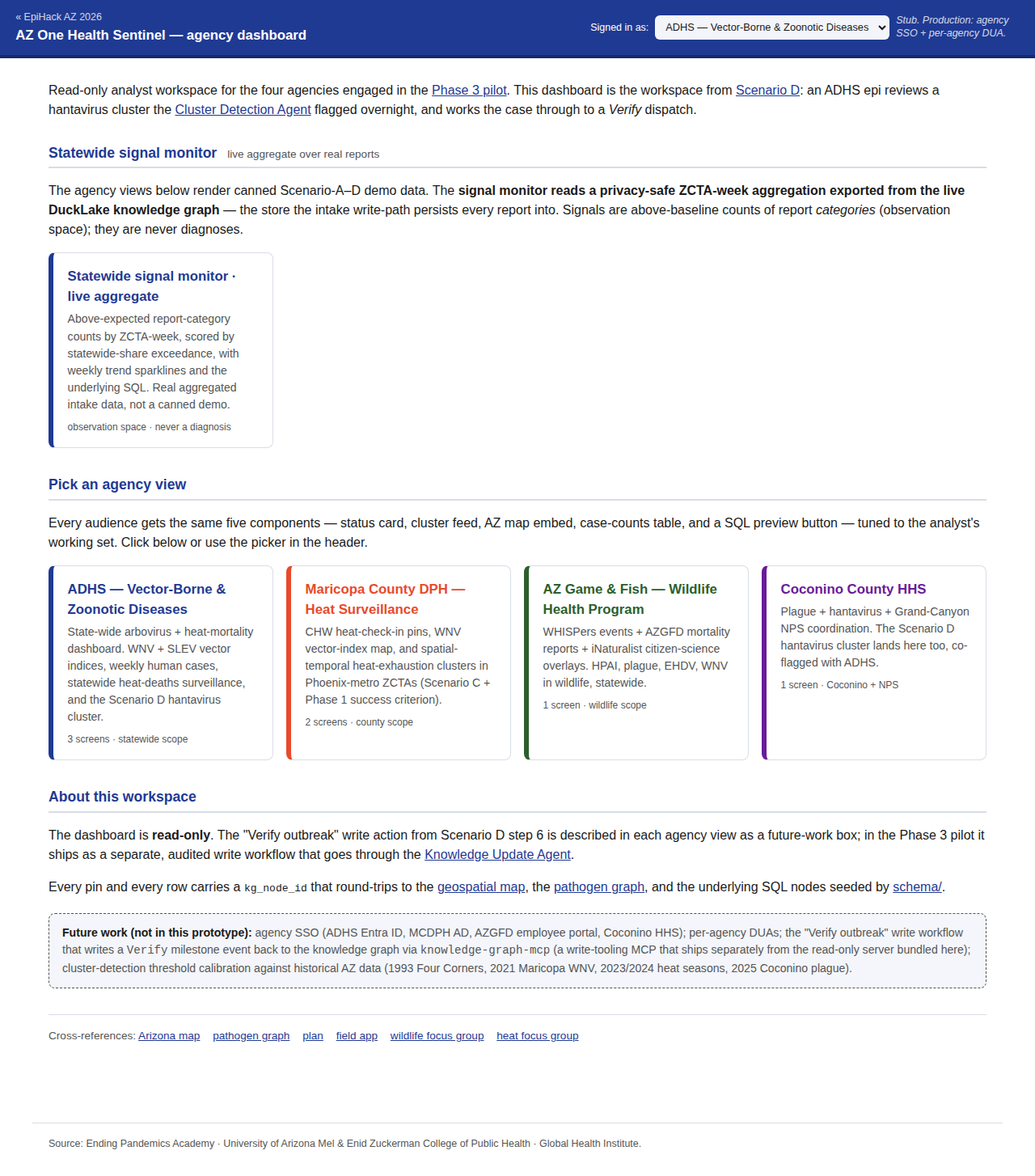
The agency dashboard at /dashboard/ is the orchestrator's read-side
window — four audiences (ADHS / MCDPH / AZGFD / Coconino), status
cards, the cluster-detection feed, a MapLibre embed, sparkline
case-count tables, and a SQL preview that round-trips to
knowledge-graph-mcp. This is Scenario D from
plan/04-data-flows.md:
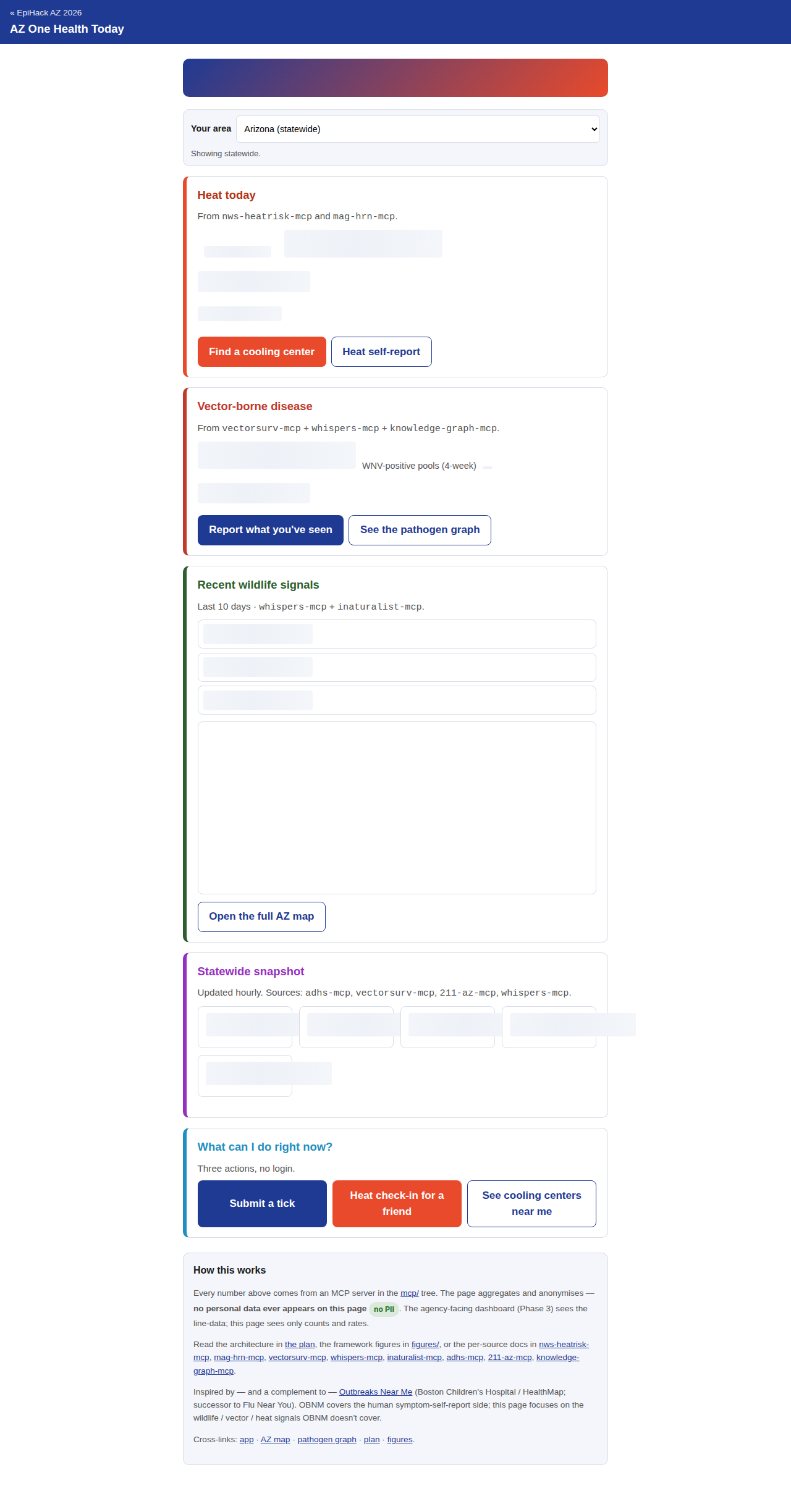
The "AZ One Health Today" page is the public-facing counterpart — same enrichment pipeline output, but ZCTA-week aggregated and small-cell suppressed before render:
Decisions & trade-offs
- Two parallel
contracts.pyfiles. The pipeline's typed messages live inagents/src/onehealth_agents/contracts.py(Pydantic v2, one sub-model per Figure-2 parameter class); the HTTP models live inagents/src/onehealth_agents/api/models.py(the wire shapes the OpenAPI spec generates against). The two are deliberately not unified — the wire shape is anonymous-first and uses closedLiteral[…]enums, while the agent-internal shape is the full Minimum-Dataset bag with every field optional. Conflating them would force the API to expose the entire Figure-2 catalog or force the agents to round-trip through anonymisation on every step. - Each branch is enum-constrained, even the LLM step. Triage's two
branches both
assert tc in HEAT_TRIAGE_CLASSES/… VBD_TRIAGE_CLASSESbefore returning. Production swaps the rule layer for an LLM forced through a structured-output schema keyed on the same enums — but the enum is the contract, not the LLM. - Failures degrade; they don't drop. Every stage in the orchestrator
is wrapped in
_timed(name, fn, …), which catches every exception, emitsAgentRun(status='failed', error=…), and lets the next stage decide whether to continue. The pipeline reachesNotificationAgenteven whenGeoEnrichmentAgentcouldn't reach the MCP; the only hard stop isValidationStatus.REJECT. - Cost accounting is in-band. Every
AgentRuncarriesprompt_tokens/completion_tokens/cache_read_tokens/cache_creation_tokensand acost_usdcomputed from the pricing table inaudit.py. The table is overridable viaCLAUDE_HAIKU_INPUT_USD_PER_Metc., so a deployment can adjust without a code change when the public rate card changes. FakeMCPClientis also the documentation. Readingwith_default_handlersis the fastest way to see what the orchestrator expects each MCP server to return. New scenarios land canned-handler- first; the real server is wired up later.
The kg_sql escape hatch is SELECT-only by parser, not by convention
knowledge-graph-mcp
exposes a raw-SQL tool for the agency dashboard's Scenario D
workflow — but the SQL parser blocks anything that isn't a SELECT.
Don't weaken that filter. It's the only reason an analyst can
re-shape a cluster query without going through a PR.
Where to go next
06 · Ship the app → — the mobile-first reporting surface that feeds this orchestrator. Or read the privacy contract end-to-end at Architecture · Privacy, the agent topology diagram at Architecture · Agents, and the worked scenarios at Architecture · Data flows.