01 · Frame the problem
What we wanted
A working knowledge framework for participatory One Health surveillance in Arizona, anchored on artifacts produced by the EpiHack participants themselves: the five reference figures from the Ending Pandemics Academy curriculum, the four guiding questions from each of two focus groups (Wildlife & Vector-Borne Disease, Heat), the completed design worksheets the teams turned in, and the World Café Q4 cards on what public engagement has actually worked in the field. The point wasn't to invent a new theory of surveillance — it was to turn the figures, focus groups, and engagement evidence into something a contributor on Monday morning could query, extend, and ship code against.
What we built
- Five reference figures, each transcribed from poster format into
structured Markdown + RDF-style triples under
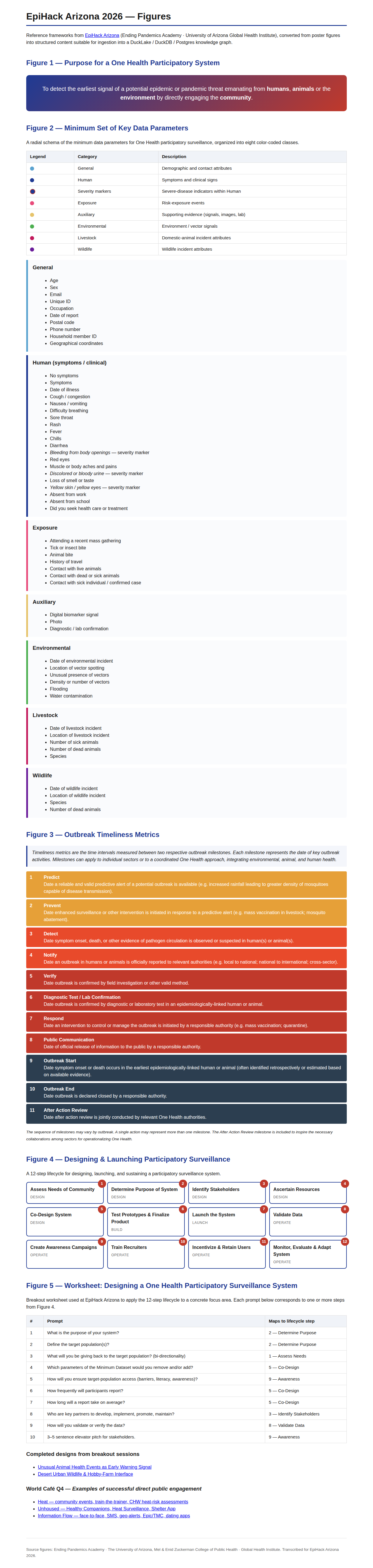
figures/. Figure 1 is the purpose statement; Figure 2 is the eight-class minimum dataset; Figure 3 is the eleven outbreak-timeliness milestones; Figure 4 is the 12-step design-and-launch lifecycle; Figure 5 is the ten-prompt design worksheet that anchors every other artifact on the page. - Two focus groups, each with four numbered guiding-question pages
plus a full anchor-resource catalog.
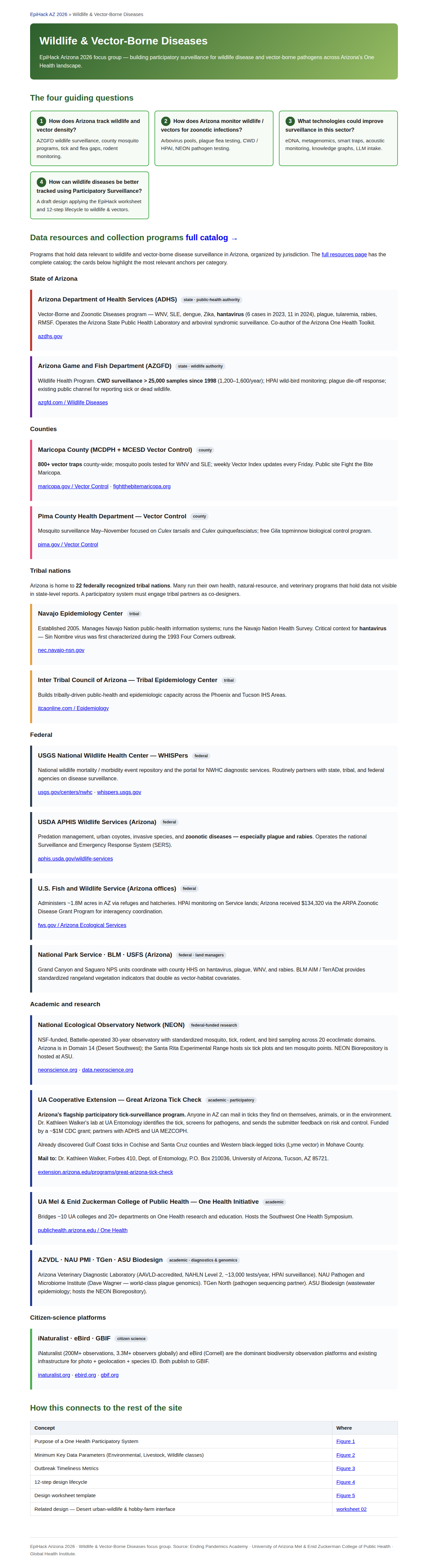
wildlife/covers wildlife tracking, zoonotic surveillance, surveillance technology, and the participatory-design draft;heat/covers cooling-center awareness, real-time resource sharing, heat safety education, and the vulnerability profile. Both resource pages span state, county, tribal, federal, academic, and citizen-science jurisdictions. - Two completed design worksheets under
worksheets/: worksheet 01 — unusual animal-health events as an early warning signal and worksheet 02 — desert urban-wildlife and hobby-farm interface. Each is a literal answer-by-answer fill-in of the ten Figure 5 prompts. - Three World Café Q4 cards transcribed from the breakout walls
under
notes/world-cafe/: Heat, Unhoused, and Information Flow. Each card answers the same Q4 prompt — "What is an example of directly engaging with the public that was really successful?" — and produced the tactic list that later seeded the Notification and Enrichment agents. - A knowledge-graph encoding of all of the above. The
ten-prompt worksheet template, the lifecycle precedence chain, the
eight parameter categories, and the completed worksheet instances
all land as
kg.node/kg.edge/kg.propertyrows inschema/system_designs.sqlandschema/world_cafe.sql. Seekg.v_design_summaryfor the wide view.
What it looks like
The five reference figures, with each parameter linked back to its
kg.node slug, look like this on the published site:
And the two focus-group landings — the Wildlife & Vector-Borne Diseases side and the Heat side, each anchoring the resource catalogs that became Plan 02:
Decisions & trade-offs
Why participatory One Health surveillance for Arizona specifically. Arizona is the hottest large metropolitan region in the United States, and the heat focus group opens with the headline numbers — more than 4,320 heat-exposure deaths between 2013 and 2024, 990 in 2023 alone, and a 36% unsheltered share of 2016 Maricopa heat deaths — that no single agency dataset captures on its own. The state is also home to 22 federally recognized tribal nations, 15 county vector-control programs, the NEON Domain 14 desert- southwest observatory at Santa Rita, and the only flagship participatory tick-surveillance program in the region (the UA Great Arizona Tick Check). The jurisdictional spread is the whole problem: any signal that matters crosses agencies before it crosses sectors.
Why VBD and Heat, and not foodborne, AMR, or opioids. Those four were on the table. We chose Vector-Borne Disease and Heat because they share a single property that the others don't: the environmental class of Figure 2 is the load-bearing one. Mosquito density, standing water, ambient temperature, HeatRisk colour, and cooling-center proximity are all real-time, machine-readable signals that an MCP server can stream without negotiating PHI access. Foodborne and AMR surveillance leans much harder on clinical records (FoodNet, NHSN, eCR) where the data-use agreements alone take longer than a hackathon. The Wildlife and Vector- Borne Disease focus group also already overlapped with Heat through shared environmental drivers (rainfall → mosquito habitat; heatwave → outdoor-worker exposure during peak WNV weeks), so two verticals could share most of the schema.
Why we kept the framework jurisdiction-aware from day one. The
World Café Q4 cards forced this. Train-the-Trainer → Western Regional
Public Health (HHS Region 9) is a 12-year-old program. Community
Health Workers → assess heat risk to homes is a tactic Maricopa CHWs
already run. Dating apps → STI services was even on a card (with the
participants' own "??" attached, which we preserved). Healthy
Companions and the shelter app came off the Unhoused card.
Geo-targeted emergency health alerts and Epic EMRs in collaboration
with TMC came off the Information Flow card. None of those tactics
work if the schema doesn't know which county, tribe, or CHW network a
report belongs to — so kg.edge(subject_id, predicate, object_id)
treats county / tribe / agency / network as first-class nodes from the
first seed, not as columns bolted on later.
Why the worksheet template is in SQL, not Markdown. Figure 5 has
ten prompts and the focus groups produced two filled-in worksheet
instances on day one. By making
schema/system_designs.sql
the canonical template (with the ten prompts as worksheet_prompt
nodes and each completed answer as a worksheet_answer edge back to
its design), the same SQL view that summarises the two completed
worksheets will summarise the thirtieth — no transcription step,
no schema drift. The
kg.v_design_summary view is the receipt.
Where the World Café tactics actually landed. The CHW heat-risk
home check became
the 211-az-mcp transport-dispatch flow.
Train-the-Trainer Region 9 maps to the Phase 1 awareness-campaign
milestones in
plan/05-roadmap.md.
The shelter app and dating-apps tactics didn't ship as code, but
they're encoded as engagement_tactic nodes in
schema/world_cafe.sql
so the next team can pull them up via
kg.v_engagement_tactics without re-reading the
cards.
Worksheet 01, prompt 9 — Validation
"Deploy first to populations like animal control, veterinarians, and veterinary students. Filter by IP address, ZIP code, frequency of reporting a particular event, veterinary follow-up, diagnostic follow-up, symptom cluster."
That single answer set the direction for three later pieces of the
stack: the
Validation Agent's coarse-geo + duplicate-suppression checks,
the Cluster Detection Agent's ZCTA-week aggregation,
and the entire privacy contract in validation.py.
The worksheets weren't decoration. They drove the build.
What the framework is not
The framework is not a survey instrument. It does not collect diagnoses. It does not run on agency record systems. It is a queryable encoding of the prior knowledge in the room — figures, focus-group materials, worksheets, and World Café cards — so every later code change can be motivated by something a reviewer can cite back to a poster, a transcript, or a worksheet answer.