03 · Build the MCPs
Source
mcp/README.md,
mcp/vectorsurv-mcp/README.md,
plan/02-mcp-integration.md,
agents/src/onehealth_agents/mcp_client.py,
and schema/deep/mcp_servers.sql.
What we wanted
Eleven LLM-callable data adapters that the agent orchestrator could
dispatch on a per-prefix basis — vectorsurv_*, kg_*, mag_*,
az211_*, gattc_*, nws_*, whispers_*, inat_*, adhs_*,
sms_*, wearable_* — all testable offline with no upstream
credentials, and shaped uniformly enough that adding a twelfth would
be a copy-modify of an existing server rather than a fresh design.
What we built
Eleven FastMCP servers, every one
scaffolded from mcp/vectorsurv-mcp/
as the template. The index in
mcp/README.md
is the canonical inventory; the per-server tool counts roll up to
76 tools across 11 servers:
| Server | Wraps | Tools | Tests |
|---|---|---|---|
| vectorsurv-mcp | VectorSurv mosquito + tick API (v1.0.44) | 13 | 6 |
| knowledge-graph-mcp | DuckDB property graph + SELECT-only SQL | 12 | 22 |
| nws-heatrisk-mcp | NWS HeatRisk + alerts + heat-index | 7 | 17 |
| adhs-mcp | ADHS public surveillance summaries | 6 | 46 |
| 211-az-mcp | 211 Arizona referrals + transport | 6 | 23 |
| whispers-mcp | USGS WHISPers wildlife mortality | 6 | 15 |
| inaturalist-mcp | iNaturalist citizen-science (AZ place_id=53) |
6 | 8 |
| sms-entry-mcp | Twilio SMS intake adapter | 6 | 19 |
| mag-hrn-mcp | MAG Heat Relief Network centers | 5 | 35 |
| great-az-tick-check-mcp | UA Cooperative Extension tick check | 5 | 10 |
| wearable-mcp | HealthKit / Health Connect readings | 4 | 23 |
(Tool and test counts mirror the table in mcp/README.md;
bumps land in the same PR that ships the change.)
Every server follows the layout enforced by the
mcp/README.md "How to add a new MCP server"
section:
mcp/<name>-mcp/
├── README.md                    # tool table + auth posture + env vars
├── pyproject.toml               # FastMCP + httpx + pydantic v2 (own uv workspace)
├── src/<package>_mcp/
│   ├── __main__.py              # `python -m <package>` entry
│   ├── server.py                # FastMCP() + @mcp.tool definitions
│   ├── client.py                # httpx wrapper; env-overridable base URL
│   └── canned_data.py | mock_data.py   # offline fallback
├── examples/claude_desktop_config.json
└── tests/test_*.py              # uv run pytest — no network
The eleven servers are also encoded as graph nodes in
schema/deep/mcp_servers.sql
(mcp_server nodes, one mcp_tool node per tool, with wraps,
exposedBy, operatedBy, and informs edges), so the knowledge
graph itself answers "which MCP tools answer Heat Q1?" in one
SQL query.
What it looks like
The eleven servers don't have a UI of their own — they're stdio-mode
MCP processes that other agents (and Claude Code itself) call into.
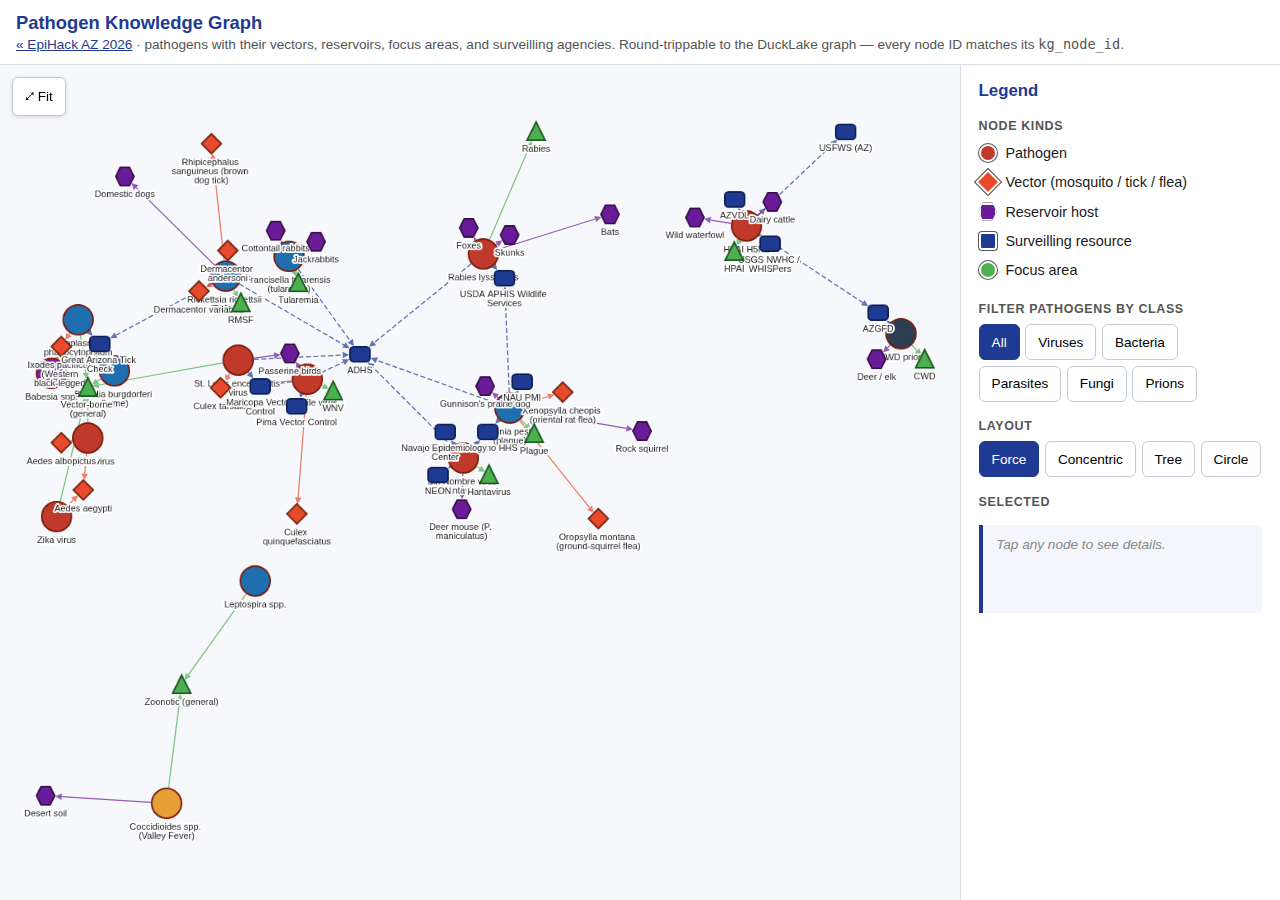
The closest visible artifact is the pathogen knowledge graph rendered
by knowledge-graph-mcp's data, served
through the Cytoscape viewer at /graph/:
The full per-server tool inventory lives at
MCP reference; each server's README.md (now
mirrored in the docs site) documents tool signatures and example calls.
Decisions & trade-offs
vectorsurv-mcp is the template, on purpose
mcp/README.md
points new contributors at mcp/vectorsurv-mcp/ and says "use it as
the template — it is the most complete reference in the family and
follows every convention reviewers expect." That isn't aspirational
prose — every other server in mcp/ was bootstrapped with
cp -R vectorsurv-mcp <new>-mcp, renamed at the package level, and
then had its client.py rewritten against the new upstream. The
result is that all eleven servers share the same file layout, the
same httpx + pydantic v2 plumbing, the same __main__.py entry,
and the same offline-by-default test pattern. A contributor who
learns one server learns ten more for free.
The trade-off: when vectorsurv-mcp evolves (it gained the
streamable-HTTP / Claude.ai custom-connector path in commit
e4c6a64), the other ten don't automatically inherit the new
capability. That's a known follow-up (see below), not a hidden
liability — the inheritance is by convention, not by code.
Per-server tool prefixes are load-bearing
The naming rule is at the top of the
mcp/README.md conventions list:
prefix every tool name with a short server prefix —
vectorsurv_, kg_, mag_, az211_, gattc_, nws_,
whispers_, inat_, adhs_, sms_, wearable_. It's not
cosmetic. The orchestrator in
agents/src/onehealth_agents/mcp_client.py
dispatches every call as client.call_tool(server, tool, **kwargs),
where the (server, tool) tuple is the registry key
(mcp_client.py lines 56-69).
A bare get_pools lookup would silently match the wrong server
once two MCPs ship a get_pools tool; prefixed
vectorsurv_get_pools and whispers_events_bbox can't collide by
construction.
Collisions silently break Scenarios A / C / D
The four worked data flows in
plan/04-data-flows.md
each chain three or four MCP calls. A tool-name collision wouldn't
fail loud — it would just dispatch to the wrong handler and return
a structurally valid response. The prefix rule is the cheapest
way to make that class of bug impossible.
Tests must pass offline — every server ships canned_data.py
mcp/README.md convention 3:
"Tests must run with no network. Put canned data in a sibling
module (canned_data.py / mock_data.py) and silently fall back on
connection errors." Combined with the
CLAUDE.md lint section
rule that "tests must not hit the network — use the per-server
canned_data.py / mock_data.py or respx", this gives every
server a deterministic offline mode. whispers-mcp,
mag-hrn-mcp, and adhs-mcp ship sizeable canned datasets (a
12-site Phoenix HRN registry, ADHS PDF transcriptions, USGS
WHISPers snapshots) and silently fall back to them when the
upstream is unreachable. The orchestrator's
FakeMCPClient.with_default_handlers()
extends the same pattern to the eight-agent test suite: every
Scenario A / C tool call has a canned response registered, so
uv run pytest inside agents/ finishes in seconds with no
sockets opened.
The kg_sql escape hatch is SELECT-only by parser, not by convention
knowledge-graph-mcp ships an kg_sql tool for "arbitrary
read-only SELECT against the kg schema" — the escape hatch an LLM
needs when none of the 11 typed kg-tools answers the question.
Letting an LLM run arbitrary SQL against a lakehouse would
ordinarily be a foot-gun; here it's enforced by
assert_select_only():
- The query must match
^\s*(?:select|with)\b(single statement). - A
_FORBIDDEN_REblocksinsert | update | delete | drop | alter | create | attach | detach | copy | truncate | grant | revoke | pragma | export | import | call | use | set | reset | vacuum | analyze | begin | commit | rollback | checkpoint | install | load(queries.pylines 343-348). - Multi-statement payloads (
;inside the trimmed query) are rejected. - The accepted SELECT is wrapped as
SELECT * FROM (<safe>) _kg_inner
  LIMIT <SQL_ROW_CAP>
so even a runaway query can't return more than the row cap.
CLAUDE.md
is explicit: "The kg_sql escape hatch in knowledge-graph-mcp is
SELECT-only by parser, not by convention. Don't weaken that filter."
Mock-by-default where the upstream has no public API
Three servers proxy data sources that don't have a public REST API
today: great-az-tick-check-mcp (UA Cooperative Extension), adhs-mcp
(ADHS publishes PDFs and ArcGIS dashboards, not JSON), and parts of
mag-hrn-mcp (the supply-status feed is mock-only until MAG ships
occupancy data). The
mcp/README.md index
column for those rows reads "Optional …_API_TOKEN for a future
real backend; defaults to mock-mode (no auth)". The
mock-by-default convention
also requires the FastMCP tool docstring to declare the mock
posture so an LLM doesn't surface mock data as authoritative.
Claude.ai custom-connector path is shipped on one server, not all
vectorsurv-mcp runs over streamable-HTTP behind nginx as a
Claude.ai custom connector at
https://epihack-test.cis240692.projects.jetstream-cloud.org/mcp/vectorsurv
(the runbook is in
mcp/vectorsurv-mcp/README.md).
The pattern is:
- Run the server with
MCP_TRANSPORT=streamable-http, bind to127.0.0.1:801N, setFASTMCP_STREAMABLE_HTTP_PATH=/mcp/<name>so nginx can pass the URI through unchanged. - Add one
location /mcp/<name>block to the ansible-rendered nginx config, withproxy_buffering offandproxy_read_timeout 3600sto hold the SSE channel open. - Register the HTTPS URL in Claude.ai's Connectors UI.
The other ten servers are still stdio-only — they work fine as
Claude Desktop / Claude Code / Cursor / Codex MCPs (their
examples/claude_desktop_config.json snippets are exact), but
they don't yet have an HTTPS-fronted remote connector. That's the
biggest known follow-up: the mcp_http_servers list in
ansible/group_vars/all.yml
already accepts more entries, and the nginx role renders one
location per entry — what's missing is the FASTMCP_* env
configuration in each server's systemd unit and a fresh round of
streamable-HTTP testing for the other ten.
Why ship the connector path on one server first
The first connector exposed three deploy-side gaps — the
FASTMCP_STREAMABLE_HTTP_PATH requirement, the nginx
proxy_buffering off need, and an Authorization header
interaction that commit
199bcfc
fixed for vectorsurv-mcp and nws-heatrisk-mcp. Better to
catch those on one server than on eleven.
MCP boundary = auth boundary
VectorSurv requires a Gateway account; the bearer JWT is held in
the MCP server process and never sent to the LLM
(plan/02-mcp-integration.md).
The same posture applies to every authenticated upstream — the
.env file lives next to the server, the LLM client receives only
the parsed response. Tribal-data MCPs also carry a sunset clause
(pyproject.toml description + a MOU_RENEWED_THROUGH env
refusal in __main__.py) per
GOVERNANCE.md;
no tribal-data server ships today, but the contract is in place.