Slide 06 · The concerns
Revised deck. In the revised deck (2026-10-31) this slide shows short taglines, and each concern has its own slide. The four chosen lines (
c1–c4) are superseded. The evidence gathered here supports the new slides:
Evidence New slide Financial 07 Environment and New Mexico 08 Training and misuse 09 Closed systems 10
Section: 01 · Fear · Slide text and notes: talk/slides.md
Notes: Take each concern seriously; do not dismiss. Each could be its own talk. The point: these deserve answers, not avoidance.
The slide had four bracketed placeholders; the chosen line for each is marked below and listed under Pending deck edits in CLAIMS.md. Each section gives the candidate one-liners (25 words or fewer), the facts behind them, and caveats. Each fact is a claim in claims.yaml, with sources and evidence paths.
1 · Financial risk: the bubble question, who carries the debt
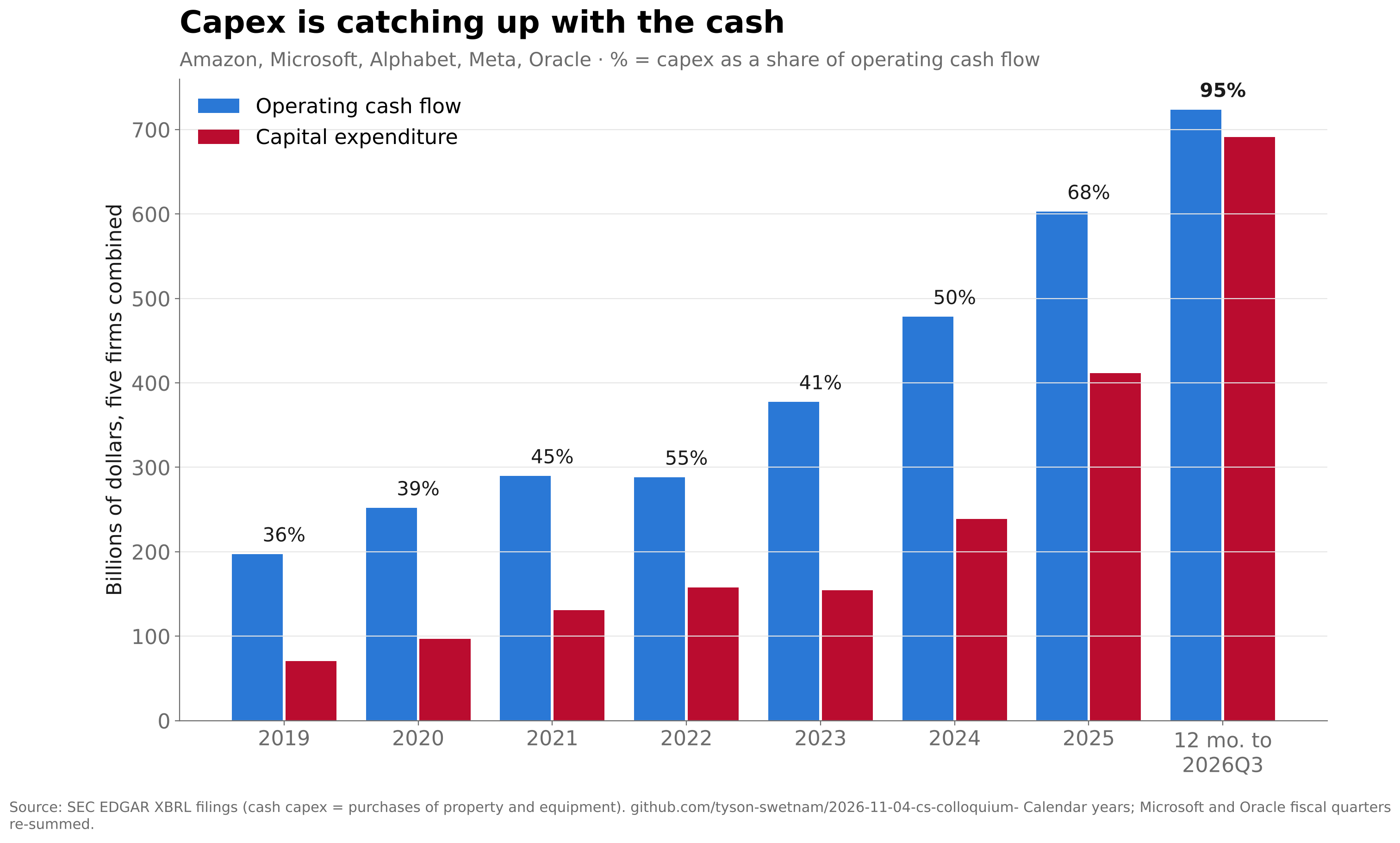
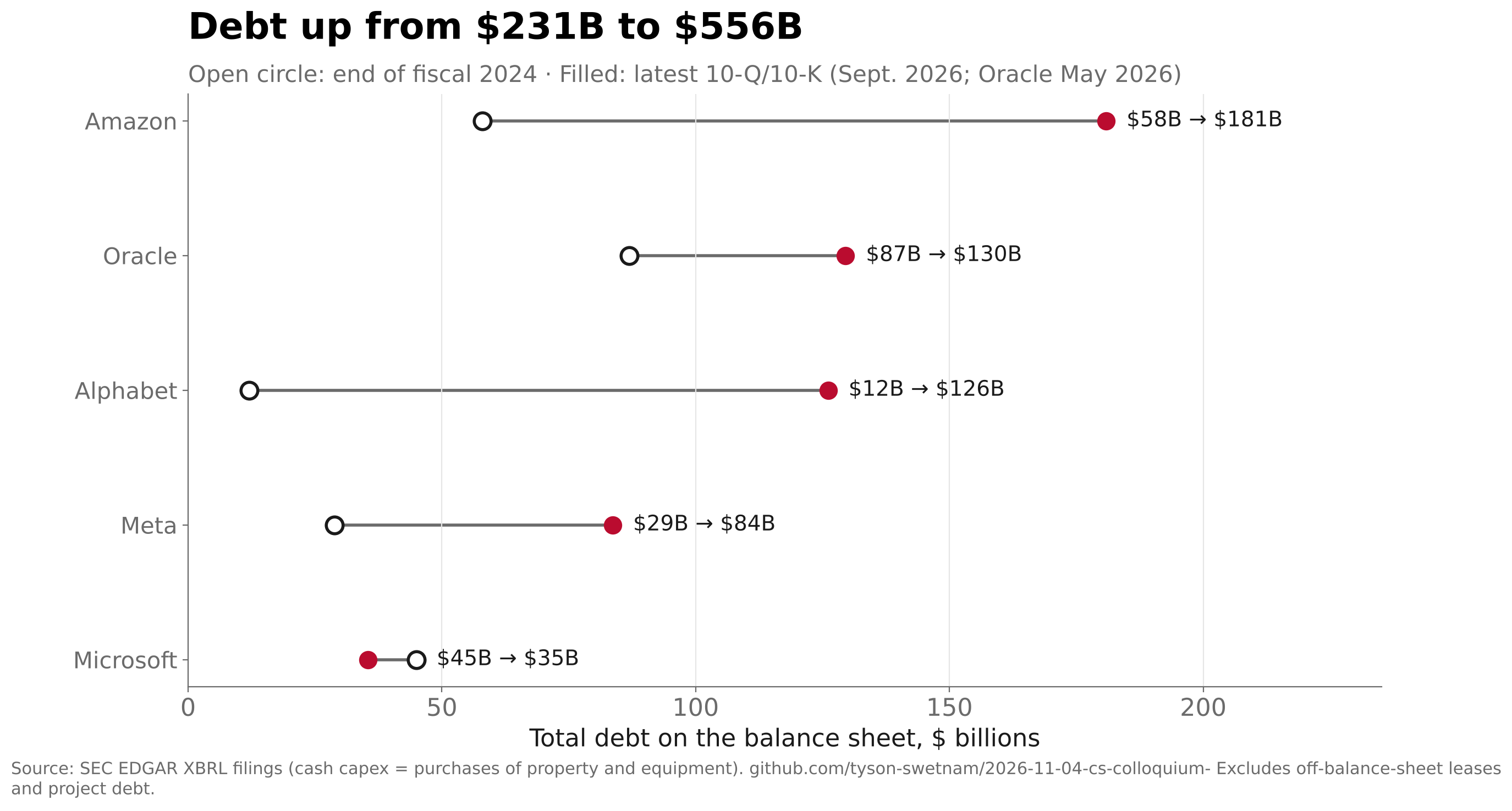
Candidate lines - Chosen (2026-10-30): "The five hyperscalers now spend 95¢ of every operating dollar on capex; their debt has more than doubled since 2024, and more sits off the books." - "Capex has caught up with cash: 95% of operating cash flow, up from 50% in 2024. The rest is borrowed, much of it off balance sheet."
| Fact | Value | Source |
|---|---|---|
| Capex ÷ operating cash flow, five firms, 12 months to 2026Q3 | 95% (36–55% in 2019–24) | SEC XBRL, computed (01_financial.py) |
| Above 100% already | Oracle 161%, Amazon 128% (Microsoft 69%) | same |
| Debt on balance sheets | $231B → $556B (FY2024 ends → latest filing) | same |
| Meta's Hyperion campus | ~$30B, ~90% debt, in an off-balance-sheet JV; debt-service coverage 1.12× | Van Nieuwerburgh (2026), §IV |
| Future leases not yet on balance sheets | ~$660B of ~$970B lease commitments | Moody's (2026), via Van Nieuwerburgh |
| Last private capex boom that busted | telecom investment fell 28% from 2000 to 2002 | BEA, via slide 05 |
Our operating cash flow and capex match Van Nieuwerburgh's Figure 1 to within 1% in every year from 2020 to 2025 (04_validate.py, validation.csv). The 95% figure uses actual results only; his 2026 figure of 113% includes guidance.
2 · Environmental cost: power, water, siting, New Mexico
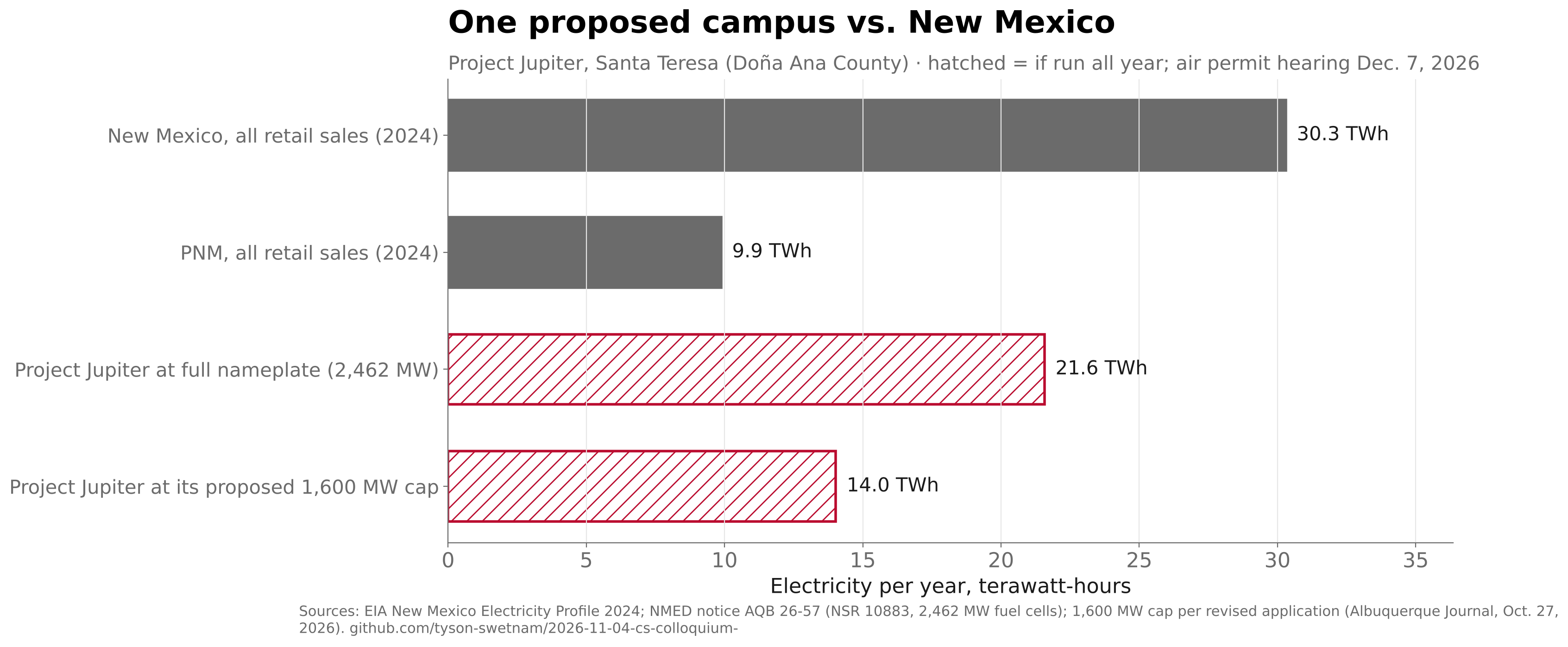
Candidate lines - Chosen (2026-10-30): "Data centers used 4.7% of U.S. power in 2024; a proposed Doña Ana County campus wants a 2.5-GW gas plant, above PNM's record peak." - "One proposed campus near Santa Teresa could use up to 46% of New Mexico's electricity; its air-permit hearing opens Dec. 7."
| Fact | Value | Source |
|---|---|---|
| US data-center electricity, 2024 | 192 TWh, 4.7% of US use; 9.5–15.3% projected for 2030 | LBNL 2025 Update (primary) |
| …compared with New Mexico | 6.3× NM's total 2024 retail sales (30.3 TWh) | EIA NM profile, computed (02_environment.py) |
| Project Jupiter power plant | 2,462 MW of gas fuel cells, = 1.09× PNM's all-time peak (2,264 MW) | NMED notice AQB 26-57 (primary); Albuquerque Journal |
| …at its proposed 1,600 MW cap, run all year | up to 14 TWh, 46% of NM retail sales | revised application, per Albuquerque Journal; computed |
| Status | air-permit hearing Dec. 7, 2026; county "potential breach" vote Oct. 27 | NMED scheduling order (primary) |
| US data-center water, 2023 | ~66B liters on site, ~800B liters through power generation | DOE national-lab slide citing LBNL 2024 (secondary) |
| PNM large-load requests, 2025 | 5,321 MW, 47% of it data centers | PNM 2026 IRP workshop (primary) |
Caveats
- Proposed, not permitted. Say "proposed", and check the news the day before the talk.
- The cap is reported, not read. The 1,600 MW cap comes from news coverage of the revised filing, not the filing itself.
- Jupiter's water claims conflict. Oracle says annual use equals nine households; opponents cite 197M gallons used during construction. See NOTES.md.
3 · Training and misuse
Candidate lines - Chosen (2026-10-30): "Courts ruled training on books fair use but pirated copies cost $1.5B; developers report AI-run hacking, and ICML caught 795 rule-breaking LLM reviews." - "Training data is still in court, with a $1.5B settlement over pirated books. Misuse is documented, from AI-orchestrated espionage to LLM-written peer reviews."
| Fact | Value | Source |
|---|---|---|
| Bartz v. Anthropic (N.D. Cal.) | training "exceedingly transformative… fair use"; pirated library not | Order, Dkt. 231 (June 2025) |
| …settlement | $1.5B, ~$3,000 per work; final approval July 20, 2026 | court notice; settlement site |
| Thomson Reuters v. ROSS (3d Cir., Sept. 2026) | a non-generative AI's use of Westlaw headnotes "was not fair" | opinion |
| AI-orchestrated espionage (developer report) | 80–90% of tactical work by an AI agent; ~30 targets | Anthropic, Nov. 2025 |
| ICML 2026 peer review | 795 reviews (~1%) broke a no-LLM pledge; 497 papers desk-rejected | ICML program chairs |
| Hallucinated citations in court filings | 2,241 decisions in Charlotin's database (Oct. 29, 2026) | database |
The threat-report numbers are the developers' own claims. The ICML count is a lower bound: reviews were caught with hidden prompts in the PDFs and checked by people, not by a text detector. Detector-based estimates, such as Pangram's 21% for ICLR, are in facts.csv, but ICLR itself calls detector accuracy "far from perfect."
4 · Researchers' work in closed systems
Candidate lines - Chosen (2026-10-30): "Nearly a quarter of The Pile is research papers; publishers have booked $185M+ licensing research to AI firms. Only 8% of researchers trust them." - "Open science trains closed models: BloombergGPT learned from 42B tokens of open research and never released its weights."
| Fact | Value | Source |
|---|---|---|
| The Pile, share of full-text papers (PMC, arXiv, PhilPapers) | 23.7% (27.1% with abstracts and NIH grants) | Gao et al. 2020 Table 1, parsed (05_corpus_shares.py) |
| BloombergGPT (weights not released) | 42B scholarly tokens, 5.9% of training | Wu et al. 2023 Table 2, parsed |
| Publisher AI licensing | Taylor & Francis $75M+ (2024); Wiley >$110M lifetime | Informa and Wiley filings |
| Authors asked? | Cambridge UP: opt-in, 40,000+ authors consulted; T&F authors reported not being told | CUP annual report; The Bookseller |
| Researcher trust | 8% trust AI firms not to use their research without permission | OUP survey, 2024 |
| PubMed Central licences | 43% CC licences that allow commercial reuse; 26% in neither reuse subset | NCBI E-utilities, computed |
| Federal public access | no-embargo access required by Dec. 31, 2025 (NIH from July 1, 2025) | OSTP Nelson memo; NIH NOT-OD-25-101 |
For balance (and for section 03): AlphaFold DB is CC-BY 4.0. Evo 2 released its weights, code and training data. OLMo's training data is open under ODC-BY.
Reproduce
make slide-05
| Script | What it does |
|---|---|
01_financial.py |
SEC filings → capex, cash flow, debt |
02_environment.py |
EIA download → New Mexico comparisons |
03_figures.py |
the three charts |
04_validate.py |
checks against Van Nieuwerburgh |
05_corpus_shares.py |
parses The Pile and BloombergGPT tables from arXiv source |
- Research write-ups. The research passes for sections 2–4 are in
data/raw/{environment,training_misuse,closed_systems}/, each withfacts.csv(verbatim quotes, URLs, dates) andNOTES.md(conflicts and blocked sources). - Source documents. These are not committed; their SHA-256 hashes are in each
sources/MANIFEST.yaml. - PubMed Central counts.
src/research/pmc_counts.shre-queries them.
Claims
| Claim | Status | Kind | |
|---|---|---|---|
c1 | Financial risk: The five hyperscalers now spend 95¢ of every operating dollar on capex; their debt has more than doubled since 2024, and more sits off the books. | 🗄️ superseded | quantitative |
c2 | Environmental cost: Data centers used 4.7% of U.S. power in 2024; a proposed Doña Ana County campus wants a 2.5-GW gas plant, above PNM's record peak. | 🗄️ superseded | quantitative |
c3 | Training and misuse: Courts ruled training on books fair use but pirated copies cost $1.5B; developers report AI-run hacking, and ICML caught 795 rule-breaking LLM reviews. | 🗄️ superseded | attribution |
c4 | Researchers' work in closed systems: Nearly a quarter of The Pile is research papers; publishers have booked $185M+ licensing research to AI firms. Only 8% of researchers trust them. | 🗄️ superseded | quantitative |
c5 | The five hyperscalers spent 95% of operating cash flow on capex in the 12 months to 2026Q3 (36-55% in 2019-2024) | 🗄️ superseded | quantitative |
c6 | Their on-balance-sheet debt rose from $231B (FY2024 year ends) to $556B (latest filings) | 🗄️ superseded | quantitative |
c7 | More sits off the balance sheet (Meta's Hyperion ~90% debt-financed in a JV; ~$660B of future leases not yet recognized) | 🗄️ superseded | attribution |
c8 | US data centers used 192 TWh in 2024, 4.7% of US electricity; 9.5-15.3% projected for 2030 | 🗄️ superseded | attribution |
c9 | Project Jupiter (Doña Ana County) seeks an air permit for 2,462 MW of gas fuel cells, more than PNM's all-time peak of 2,264 MW | 🗄️ superseded | quantitative |
c10 | US data centers consumed ~66 billion liters of water on site in 2023, and ~800 billion liters more through electricity generation | 🗄️ superseded | attribution |
c11 | Training on books was ruled fair use, but pirated copies were not; Bartz v. Anthropic settled for $1.5B (~$3,000 per work), final approval July 20, 2026 | 🗄️ superseded | factual |
c12 | Developers report real misuse, e.g. a state-sponsored group ran 80-90% of an espionage campaign's tactical work with an AI agent (~30 targets) | 🗄️ superseded | attribution |
c13 | ICML 2026 caught 795 reviews (~1%) by reviewers who had pledged not to use LLMs; 497 papers were desk-rejected | 🗄️ superseded | factual |
c14 | 23.7% of The Pile is full-text research papers (PubMed Central, arXiv, PhilPapers); 27.1% with abstracts and grant text | 🗄️ superseded | quantitative |
c15 | Taylor & Francis ($75M+ in 2024) and Wiley (>$110M lifetime) have booked at least $185M from licensing content to AI firms | 🗄️ superseded | attribution |
c16 | Only 8% of researchers trust AI companies not to use their research data without permission | 🗄️ superseded | attribution |
c17 | Taglines: whose debt is it? · power, water, location siting · how models are trained, how they are misused · researchers' work stolen? (openai/math) | ➖ not-applicable | qualitative |
Source: slides/06-the-concerns · open the deck