---
title: "Rainbow Moon"
description: "Winfree's own puzzle: why you have never seen the Moon sitting inside the colour band of a rainbow, when it can happen, and what a failed prediction says about your assumptions."
type: Activity
tags: [course, student-facing, problem, section-3, rainbow, moon, observation, evidence]
status: stable
problem:
section: 3
session: 15
identification: confident
kind: puzzle
generated:
by: "claude/opus-5"
at: "2026-09-16T00:00:00Z"
sources:
- id: winfree-sas08-2002
resource: "https://web.archive.org/web/20030114040501/http://eebweb.arizona.edu/faculty/winfree/SAS/SAS08/SAS08.html"
title: "Adventure of the Rainbow Moon (Adventures in Discovery column SAS08, 11 January 2002)"
author: "Arthur T. Winfree"
- id: winfree-sas09-2002
resource: "https://web.archive.org/web/20030114041305/http://eebweb.arizona.edu/faculty/winfree/SAS/SAS09/SAS09.html"
title: "Adventure of the Rainbow Moon: crucial experiment this afternoon in Tucson (SAS09, 25 January 2002)"
author: "Arthur T. Winfree"
- id: winfree-sas10-2002
resource: "https://web.archive.org/web/20040106042325/http://eebweb.arizona.edu/faculty/winfree/SAS/SAS10/SAS10.html"
title: "Moon Violates Reason (SAS10, 8 February 2002)"
author: "Arthur T. Winfree"
- id: winfree-asd-intro
resource: "https://web.archive.org/web/20030114041921/http://eebweb.arizona.edu/faculty/winfree/SAS/asdIntro.html"
title: "About This Column (Adventures in Discovery introduction)"
author: "Arthur T. Winfree"
- id: sky-telescope-index-2001
resource: "https://archive.org/details/sim_sky-and-telescope_2001_101_index"
title: "The Near Sky: A Circumzenithal-Arc-Tinted Moon, Sky & Telescope 101(1): 112 (January 2001), via the 2001 volume index"
author: "Fred Schaaf"
- id: wikipedia-rainbow
resource: "https://en.wikipedia.org/wiki/Rainbow"
title: "Rainbow"
author: "Wikipedia contributors"
- id: wikipedia-lunar-theory
resource: "https://en.wikipedia.org/wiki/Lunar_theory"
title: "Lunar theory"
author: "Wikipedia contributors"
- id: wikipedia-moonbow
resource: "https://en.wikipedia.org/wiki/Moonbow"
title: "Moonbow"
author: "Wikipedia contributors"
- id: jpl-horizons
resource: "https://ssd.jpl.nasa.gov/horizons/app.html"
title: "JPL Horizons System"
author: "NASA Jet Propulsion Laboratory, Solar System Dynamics"
- id: usno-moon-phases
resource: "https://aa.usno.navy.mil/data/MoonPhases"
title: "Phases of the Moon"
author: "US Naval Observatory, Astronomical Applications Department"
- id: aosd-syllabus
resource: "https://github.com/tyson-swetnam/aosd/blob/main/docs/assets/aosd_syllabus.pdf"
title: "The Art of Scientific Discovery: original course syllabus (PDF)"
author: "Arthur T. Winfree"
---
# Rainbow Moon

This work is licensed under a Creative Commons Attribution 4.0 International License.
*[Section 3](https://tyson-swetnam.github.io/aosd/section3/index.md), session 15. The same session takes up [Mother Nature as magician; hallucinations](https://tyson-swetnam.github.io/aosd/problems/mother-nature-as-magician/index.md) and the last observations for the [chemical pattern-formation lab](https://tyson-swetnam.github.io/aosd/problems/chemical-pattern-formation-lab/index.md).*
!!! abstract "The problem"
Winfree opened this puzzle with a bet: *"I bet you never saw the Moon in
the sky behind the color band of an earthly rainbow. Why not? or have
you?"* (A. T. Winfree, "Adventure of the Rainbow Moon", 11 January 2002.) The rest
of this box is the editors' paraphrase.
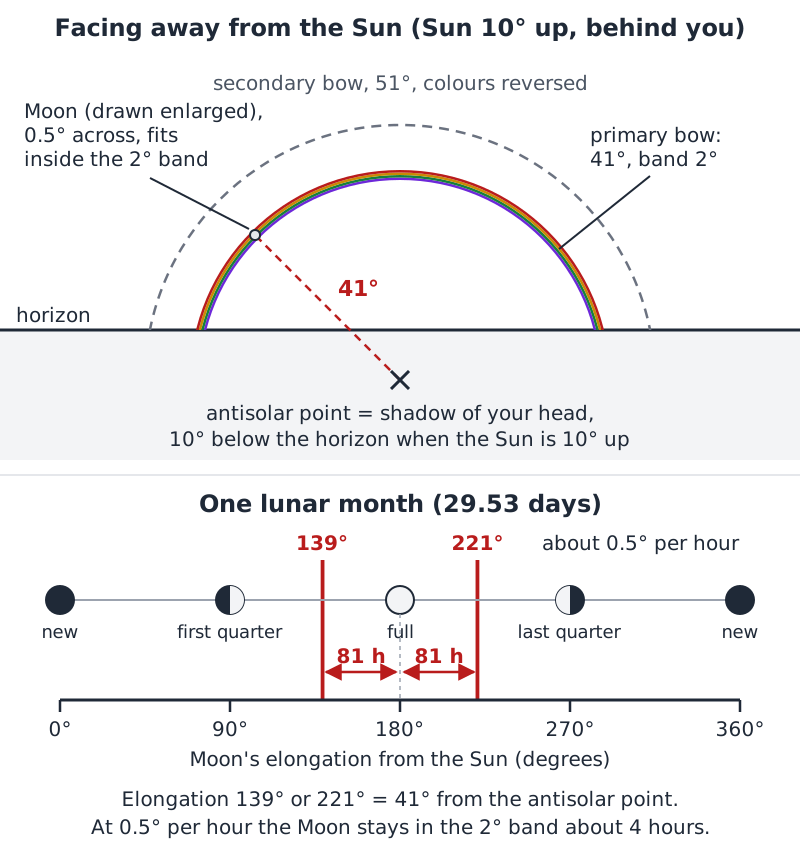
1. **Could it happen?** A rainbow is part of a circle centred on the
point opposite the Sun, marked by the shadow of your head. The primary
bow lies about 41 degrees from that point, with a colour band about 2
degrees wide; the Moon is half a degree across. Where is the Moon at
full moon, and at the quarters? Must it cross the ring?
2. **When?** The Moon drifts about half a degree per hour against the
stars. Predict how many hours before or after full moon it sits in the
band. The Sun must be up to make the bow, the Moon up to be seen, and
there must be rain or spray. What fraction of all time is left?
3. **Go and look**, with a table of full-moon times and a spray bottle,
both when a Rainbow Moon is predicted and when it is not. If the
prediction fails, ask which quiet assumption is wrong, and design an
observation that tests it.
{ width="560" }
*Drawn for this site (CC BY 4.0).*
## Why it is in the course
Section 3 is "Observations and Questions". Session 15 assigns Judson's chapter on *Evidence* beside "Mother Nature as magician; hallucinations", one session after [What Isn't There](https://tyson-swetnam.github.io/aosd/problems/what-isnt-there/index.md). The Rainbow Moon starts from an absence: something you have never seen and would never notice missing.
It needs nothing but a spray bottle, yet it goes straight to evidence. A prediction that keeps failing is data about your assumptions, not only about the sky.
The schedule dates the discussion to 9 October 2001, though Winfree calls it "a retrospective syllabus of Spring 2001". On either reading the class met the puzzle while it was still open: Winfree's first sighting came by accident on 6 September 2001, his month of measurements began on 18 September, and he did not write any of it up until January 2002.
## Where it comes from
The puzzle is Winfree's own. He worked on it through 2001 as one of his daily "Gamesworth" exercises. He then published it in his column "Adventures in Discovery" for the Society for Amateur Scientists: SAS08 and SAS09 in January 2002, with a coda in SAS10 (February 2002).
He credits Fred Schaaf in *Sky & Telescope* (January 2001, p. 112) for drawing his attention to it. The magazine's index shows that Schaaf's item was about a circumzenithal arc, which ice crystals make, not a raindrop bow.
It is not the moonbow, a rainbow made by moonlight. An earlier draft of this site guessed that.
{ width="560" }
*A rainbow is really a circle; from the air you can see almost all of it. Photo by Jakob Owens (Unsplash), March 2017, CC0, via [Wikimedia Commons](https://commons.wikimedia.org/wiki/File:Full_Rainbow_%28Unsplash%29.jpg){target=_blank}.*
??? tip "Hints"
- Pin down the rainbow first: its centre, its radius, and its band width
compared with the Moon. A fingertip at arm's length spans about two
degrees.
- The full Moon sits at the antisolar point; the quarter Moon is 90
degrees from it. Convert 41 degrees at half a degree per hour into
hours.
- If your predicted times come up empty, list the assumptions behind
them (uniform speed, a circular orbit, a fixed observer) and find a
simple daily measurement that tests each one.
## What happened
It can happen. The Moon crosses the ring twice a month, roughly 81 hours before and after full moon, and stays in the band about four hours. Both the Sun and the Moon must be up, and with 139 degrees between them one of them sets within about three hours. Winfree put the chance at about one thirty-second of one percent of all time, before even asking for rain.
From January to August 2001 he watched at his predicted times and never saw one. Then at 07:33 on 6 September 2001, in Tucson, he spotted one by accident, 89 hours after full moon: eight hours late. He had been trying to confirm predictions, he concluded, when he should have used observation to test the assumptions behind them.
From 18 September he measured the Moon's angle from the Sun, the antisolar point or a star on every clear day for a month. He used a plastic sextant and a cross-staff he had built himself. He found:
1. The Moon's speed is not uniform: it ran up to 7-8 degrees ahead of or behind schedule, enough to shift a Rainbow Moon by up to 15 hours. His 8-hour miss in September was well within that.
2. Its apparent diameter changed by about one part in eight, so the orbit is not a circle centred on Earth. Angular speed divided by diameter squared stayed roughly constant, as Kepler's second law predicts; the JPL Horizons ephemeris confirmed it.
3. A daily wobble of about one degree is parallax from standing on a rotating Earth.
Behind all this lies the Sun's uneven pull on Earth and Moon, the three-body problem that troubled Newton.
His calculations also cleared up an older sighting. At 4 PM on 6 March 2001 he thought he had seen a Rainbow Moon, but the Moon was then only 39 degrees from the antisolar point, too close for a water bow. That day his spray bottle held mostly alcohol. Alcohol bends light more strongly than water, so, he reasoned, the bow shrank enough to reach the Moon.
Using Horizons, he listed eight dates in 2002 when Tucson could see a Rainbow Moon. He tried the first on 25 January 2002, in the Catalina Foothills. The Moon cleared a ridge at 15:12. He made a bow with a garden hose, checked with the sextant that it stood 41 degrees from his head's shadow, and photographed the scene. At 15:46 the Moon was about 39 degrees from the antisolar point (Horizons gave 39.6): about four Moon diameters inside the main band. The timing was marginal; two hours earlier would have been perfect, but the Moon had not yet risen. In the spray, a fainter bow just inside the main one crossed the Moon. He also caught a software error: his planetarium program ignored parallax, worth up to two hours here.
## Sources
- **Arthur T. Winfree**, "Adventure of the Rainbow Moon", *Adventures in Discovery* column SAS08, Society for Amateur Scientists E-Bulletin (11 January 2002) — [archived copy](https://web.archive.org/web/20030114040501/http://eebweb.arizona.edu/faculty/winfree/SAS/SAS08/SAS08.html){target=_blank} 🔓 (copyright Winfree; paraphrased here)
- **Arthur T. Winfree**, "Adventure of the Rainbow Moon: crucial experiment this afternoon in Tucson", SAS09 (25 January 2002) — [archived copy](https://web.archive.org/web/20030114041305/http://eebweb.arizona.edu/faculty/winfree/SAS/SAS09/SAS09.html){target=_blank} 🔓
- **Arthur T. Winfree**, "Moon Violates Reason", SAS10 (8 February 2002) — [archived copy](https://web.archive.org/web/20040106042325/http://eebweb.arizona.edu/faculty/winfree/SAS/SAS10/SAS10.html){target=_blank} 🔓 (the 25 January 2002 observation)
- **Arthur T. Winfree**, "About This Column", introduction to *Adventures in Discovery* — [archived copy](https://web.archive.org/web/20030114041921/http://eebweb.arizona.edu/faculty/winfree/SAS/asdIntro.html){target=_blank} 🔓
- **Fred Schaaf**, "The Near Sky: A Circumzenithal-Arc-Tinted Moon", *Sky & Telescope* 101(1): 112 (January 2001), as listed in the 2001 volume index — [Internet Archive](https://archive.org/details/sim_sky-and-telescope_2001_101_index){target=_blank} 🔓 (the article itself was not read)
- **Wikipedia contributors**, "Rainbow" — [Wikipedia](https://en.wikipedia.org/wiki/Rainbow){target=_blank} 🔓
- **Wikipedia contributors**, "Lunar theory" — [Wikipedia](https://en.wikipedia.org/wiki/Lunar_theory){target=_blank} 🔓
- **Wikipedia contributors**, "Moonbow" — [Wikipedia](https://en.wikipedia.org/wiki/Moonbow){target=_blank} 🔓 (for contrast)
- **NASA Jet Propulsion Laboratory**, Horizons System — [ssd.jpl.nasa.gov](https://ssd.jpl.nasa.gov/horizons/app.html){target=_blank} 🔓 (phase angle for your own site)
- **US Naval Observatory**, Phases of the Moon — [aa.usno.navy.mil](https://aa.usno.navy.mil/data/MoonPhases){target=_blank} 🔓
- **Arthur T. Winfree**, *The Art of Scientific Discovery*: original course syllabus — [PDF](https://github.com/tyson-swetnam/aosd/blob/main/docs/assets/aosd_syllabus.pdf){target=_blank} 🔓
---
*Back to [Section 3](https://tyson-swetnam.github.io/aosd/section3/index.md) · [All problems](https://tyson-swetnam.github.io/aosd/problems/index.md) · [The schedule](https://tyson-swetnam.github.io/aosd/syllabus/index.md#section-3-observations-and-questions)*