---
title: "Laws of a Toy Universe"
description: "A class lab: watch a grid of cells change generation by generation, work out the hidden law that drives it, then design an experiment that could prove your law wrong."
type: Activity
tags: [course, student-facing, problem, section-5, cellular-automata, strong-inference, induction]
status: stable
problem:
section: 5
session: 28
identification: confident
kind: lab
generated:
by: "claude/opus-5"
at: "2026-09-16T00:00:00Z"
sources:
- id: winfree-handout-2002
resource: "https://web.archive.org/web/20020420212713/http://eebweb.arizona.edu/Faculty/Winfree/handout_479.htm"
title: "The Art of Scientific Discovery (ECOL 479/579): course handout, archived 20 April 2002"
author: "Arthur T. Winfree"
- id: gardner-1970-text
resource: "https://www.ibiblio.org/lifepatterns/october1970.html"
title: "Mathematical Games: The fantastic combinations of John Conway's new solitaire game 'life' (full text reproduction)"
author: "Martin Gardner"
- id: gardner-1970
resource: "https://www.scientificamerican.com/article/mathematical-games-1970-10/"
title: "Mathematical Games (October 1970)"
author: "Martin Gardner"
- id: wikipedia-game-of-life
resource: "https://en.wikipedia.org/wiki/Conway%27s_Game_of_Life"
title: "Conway's Game of Life"
author: "Wikipedia contributors"
- id: poundstone-1985
resource: "https://archive.org/details/recursiveunivers00poun"
title: "The Recursive Universe: Cosmic Complexity and the Limits of Scientific Knowledge"
author: "William Poundstone"
- id: berlekamp-conway-guy-1982
resource: "https://archive.org/details/winningwaysforyo02berl"
title: "Winning Ways for Your Mathematical Plays"
author: "Elwyn R. Berlekamp, John H. Conway and Richard K. Guy"
- id: feynman-1965
resource: "https://archive.org/details/characterofphysi0000feyn"
title: "The Character of Physical Law"
author: "Richard P. Feynman"
- id: golly
resource: "https://golly.sourceforge.io/"
title: "Golly: open-source cellular-automaton explorer"
author: "Andrew Trevorrow, Tom Rokicki and others"
- id: playgameoflife
resource: "https://playgameoflife.com/"
title: "Play John Conway's Game of Life (browser simulator)"
author: "Edwin Martin"
- id: aosd-syllabus
resource: "https://github.com/tyson-swetnam/aosd/blob/main/docs/assets/aosd_syllabus.pdf"
title: "The Art of Scientific Discovery: original course syllabus (PDF)"
author: "Arthur T. Winfree"
---
# Laws of a Toy Universe

This work is licensed under a Creative Commons Attribution 4.0 International License.
*[Section 5](https://tyson-swetnam.github.io/aosd/section5/index.md), session 28, finished in session 29. The same session deals with [The Miracle of FujiYama](https://tyson-swetnam.github.io/aosd/problems/miracle-of-fujiyama/index.md) and finishes the theory of [LoShu](https://tyson-swetnam.github.io/aosd/problems/loshu-lab/index.md).*
!!! abstract "The problem"
A reconstruction. The syllabus names the exercise and Winfree's handout
identifies the universe (see "Where it comes from"), but how he ran it
in class is not recorded. The runs below were computed for this page.
A universe is a large grid of cells, each **occupied** or **empty**.
Time runs in ticks and the whole grid changes at once: each generation
fixes the next completely, with no chance and no outside input.
You are not told the law, but you may ask for any starting pattern to be
run. **Find The Laws**: a rule that predicts every next frame from the
present one.
Four runs (`#` occupied, `.` empty):
```
Run A
gen 0 gen 1 gen 2
..... ..... .....
..... ..#.. .....
.###. ..#.. .###.
..... ..#.. .....
..... ..... .....
Run B
gen 0 gen 1
.... ....
.##. .##.
.##. .##.
.... ....
Run C
gen 0 gen 1 gen 2 gen 3 gen 4
.#..... ....... ....... ....... .......
..#.... #.#.... ..#.... .#..... ..#....
###.... .##.... #.#.... ..##... ...#...
....... .#..... .##.... .##.... .###...
....... ....... ....... ....... .......
Run D
gen 0 gen 1 gen 2 gen 3
........ ........ ........ ........
........ ...#.... ...#.... ..###...
..###... ..#.#... ..###... .#...#..
..###... .#...#.. .##.##.. .#...#..
..###... ..#.#... ..###... .#...#..
........ ...#.... ...#.... ..###...
........ ........ ........ ........
```
Answer in this order:
1. What is the law? State it so precisely that a stranger could compute
generation 1 from generation 0 without asking you anything.
2. What would you have to see to know your law is wrong? Construct that
test before you look.
3. Is your law the only one that fits everything you have seen? How
would you tell?
{ width="560" }
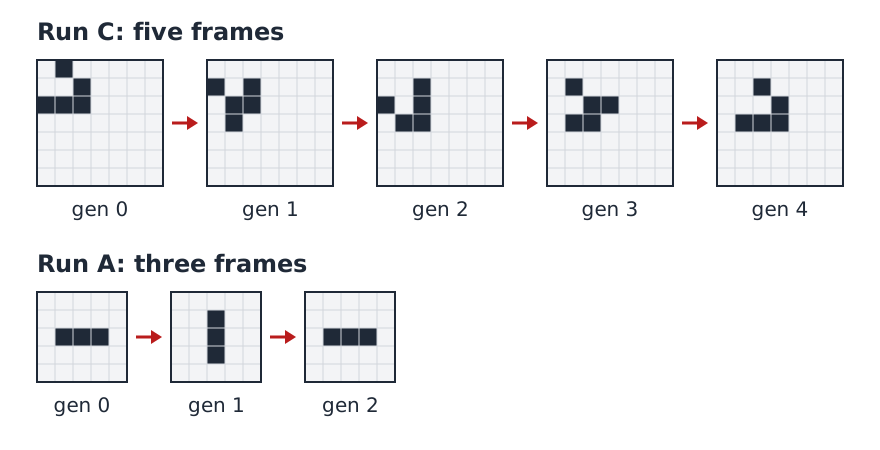
*Runs C and A from the box above; dark squares are occupied cells. Drawn for this site (CC BY 4.0).*
## Why it is in the course
Section 5 is "Inferences, Hypotheses, Explanations". Its readings run from
Chamberlin's multiple working hypotheses (session 25) through Platt's
*Strong Inference* (27) to Judson's *Strong Predictions* (28). Session 28
says "Start discovering laws of a toy universe in class"; session 29, with
Feynman's *The Character of Physical Law*, says "Finish collaborative
discovery of The Laws".
A toy universe is the cleanest laboratory there is: few, exact, local laws,
free data, no instrument error. A class can hold rival rules at once, find
the pattern they disagree about, run only that, and discard what fails. It
is the kind of joint in-class problem the syllabus describes, one that needs
"lots of data-collecting, best pooled from many sources".
The lab also shows that no finite set of observations forces one law. A
class can agree on The Laws and still be wrong about a case its patterns
never visited. That is the gap the syllabus named back in session 4:
"distinguishing things we know vs only imagine".
## Where it comes from
The syllabus gives only the two schedule lines. The universe has a well-known
name, and the name gives the answer away, so the history is folded below.
Work on the runs first.
??? info "Which universe is it? (names the answer)"
In Winfree's course handout (Wayback Machine capture, April 2002), the
links on "toy universe" (session 28) and "The Laws" (session 29) both
point to a bookmark named `Game_of_Life`. The bookmarks led into a
problem document that was not archived, so Winfree's own write-up of the
exercise does not survive.
John Horton Conway devised the Game of Life in 1970. Martin Gardner's
"Mathematical Games" column in *Scientific American* (October 1970) brought
it to the public, setting out Conway's rules for survival, death and birth. The
column started an amateur research programme: Bill Gosper's group at MIT
won Conway's $50 prize for showing that a pattern can grow without
limit, with the glider gun. Conway's own treatment is in *Winning Ways for Your
Mathematical Plays* (1982), and William Poundstone's *The Recursive
Universe* (1985) uses Life to ask how much its laws let an observer
know.
??? tip "Hints"
- Assume the law is local and the same everywhere; check that against
Run D.
- Is a neighbour one of four cells (edges) or eight (with corners)? Run A
settles it: with four, the empty cell above the row's middle and the
one beyond its end have equal counts, yet only one fills.
- Ask separately when an occupied cell survives and when an empty cell
fills.
- Tabulate neighbour count against what happened next. The rule appears
in the table, not the pictures.
- When two rules survive, run the pattern they disagree about.
??? success "Resolution"
**The Laws.** Each cell has eight neighbours (edge or corner). All cells
update at once from the previous generation:
- an occupied cell with **two or three** occupied neighbours stays
occupied;
- an occupied cell with fewer than two, or more than three, becomes
empty (isolation, overcrowding);
- an empty cell with **exactly three** occupied neighbours becomes
occupied.
In shorthand, **B3/S23**: birth on 3, survival on 2 or 3. This is
Conway's Game of Life.
Run A is the *blinker*: the end cells die with one neighbour, the middle
survives on two, and the cells above and below are born on three. Run B,
the *block*, never changes. Run C, the *glider*, regains its shape after
four generations one cell along the diagonal. Run D's square loses its
centre to overcrowding and opens into a ring.
Two points matter more than the rule.
1. *The data never forced it.* Any rule agreeing with B3/S23 on the
cases these runs visited fits equally well; only a test of an
unvisited case decides. These runs never show an empty cell with six
or seven occupied neighbours, or an occupied cell with none, six or
seven.
2. *Knowing the law is not knowing the universe.* Life is
Turing-complete: anything a computer can calculate can be calculated
inside it. So there is no general shortcut for predicting whether a
pattern dies, settles or grows forever; usually you have to run it.
To stage it, show frames on a simulator such as Golly, never the rule,
and name the game only after The Laws are agreed.
## Sources
- **Arthur T. Winfree**, *The Art of Scientific Discovery* (ECOL 479/579), course handout; the session 28 and 29 lines and their bookmark — [Wayback Machine capture, 20 April 2002](https://web.archive.org/web/20020420212713/http://eebweb.arizona.edu/Faculty/Winfree/handout_479.htm){target=_blank} 🔓
- **Martin Gardner**, "Mathematical Games: The fantastic combinations of John Conway's new solitaire game 'life'", *Scientific American* 223(4), 120–123 (October 1970) — [full-text reproduction](https://www.ibiblio.org/lifepatterns/october1970.html){target=_blank} 🔓 · [publisher page](https://www.scientificamerican.com/article/mathematical-games-1970-10/){target=_blank} 🔒
- **William Poundstone**, *The Recursive Universe: Cosmic Complexity and the Limits of Scientific Knowledge* (1985) — [Internet Archive](https://archive.org/details/recursiveunivers00poun){target=_blank} 🔓 *(borrow)*
- **Elwyn R. Berlekamp, John H. Conway and Richard K. Guy**, *Winning Ways for Your Mathematical Plays*, vol. 2 (1982) — [Internet Archive](https://archive.org/details/winningwaysforyo02berl){target=_blank} 🔒
- **Richard P. Feynman**, *The Character of Physical Law* (1965), the session 29 reading — [Internet Archive](https://archive.org/details/characterofphysi0000feyn){target=_blank} 🔒
- **Wikipedia contributors**, "Conway's Game of Life" — [Wikipedia](https://en.wikipedia.org/wiki/Conway%27s_Game_of_Life){target=_blank} 🔓
- **Andrew Trevorrow, Tom Rokicki and others**, *Golly*, open-source cellular-automaton explorer — [golly.sourceforge.io](https://golly.sourceforge.io/){target=_blank} 🔓
- **Edwin Martin**, *Play John Conway's Game of Life*, browser simulator — [playgameoflife.com](https://playgameoflife.com/){target=_blank} 🔓
- **Arthur T. Winfree**, *The Art of Scientific Discovery*: original course syllabus — [PDF](https://github.com/tyson-swetnam/aosd/blob/main/docs/assets/aosd_syllabus.pdf){target=_blank} 🔓
---
*Back to [Section 5](https://tyson-swetnam.github.io/aosd/section5/index.md) · [All problems](https://tyson-swetnam.github.io/aosd/problems/index.md) · [The schedule](https://tyson-swetnam.github.io/aosd/syllabus/index.md#section-5-inferences-hypotheses-explanations)*