---
title: "Evaporated Gold"
description: "An unidentified session-6 item, reconstructed here as an order-of-magnitude estimate of a vacuum-deposited gold film, where the wrong answer comes from an assumption nobody noticed making."
type: Activity
tags: [course, student-facing, problem, section-1, estimation, hidden-assumptions, error-checking, thin-films]
status: stable
problem:
section: 1
session: 6
identification: unknown
kind: puzzle
generated:
by: "claude/fable-5-1"
at: "2026-09-16T00:00:00Z"
sources:
- id: winfree-handout-2001
resource: "https://web.archive.org/web/20030111064604/http://eebweb.arizona.edu/faculty/winfree/Handout_479.htm"
title: "The Art of Scientific Discovery: course handout and retrospective syllabus (479/479H/579, Ecology and Evolutionary Biology, University of Arizona), Wayback Machine capture"
author: "Arthur T. Winfree"
- id: winfree-home-page
resource: "https://web.archive.org/web/20021225142609/http://eebweb.arizona.edu/faculty/winfree/"
title: "A. T. Winfree faculty home page (Wayback Machine capture, 25 Dec 2002)"
author: "Arthur T. Winfree"
- id: evaporation-deposition
resource: "https://en.wikipedia.org/wiki/Evaporation_(deposition)"
title: "Evaporation (deposition)"
author: "Wikipedia contributors"
- id: gold-wikipedia
resource: "https://en.wikipedia.org/wiki/Gold"
title: "Gold"
author: "Wikipedia contributors"
- id: faraday-1857
resource: "https://commons.wikimedia.org/wiki/File:The_Bakerian_Lecture-_Experimental_Relations_of_Gold_(and_Other_Metals)_to_Light_(IA_jstor-108616).pdf"
title: "The Bakerian Lecture: Experimental Relations of Gold (and Other Metals) to Light. Philosophical Transactions of the Royal Society of London 147: 145-181"
author: "Michael Faraday"
- id: fermi-problem
resource: "https://en.wikipedia.org/wiki/Fermi_problem"
title: "Fermi problem"
author: "Wikipedia contributors"
- id: fritz-haber
resource: "https://en.wikipedia.org/wiki/Fritz_Haber"
title: "Fritz Haber"
author: "Wikipedia contributors"
- id: haber-1927
resource: "https://doi.org/10.1002/ange.19270401103"
title: "Das Gold im Meerwasser. Angewandte Chemie (then Zeitschrift fuer angewandte Chemie) 40(11): 303-314"
author: "Fritz Haber"
- id: gold-in-sea-water
resource: "https://www.911metallurgist.com/blog/how-much-gold-sea-water/"
title: "How much Gold in Sea Water"
author: "911 Metallurgist (reprinting an older mining-engineering article)"
- id: ehrlich-nine-crazy-ideas
resource: "https://press.princeton.edu/books/paperback/9780691094953/nine-crazy-ideas-in-science"
title: "Nine Crazy Ideas in Science: A Few Might Even Be True (publisher page)"
author: "Robert Ehrlich"
- id: aosd-syllabus
resource: "https://github.com/tyson-swetnam/aosd/blob/main/docs/assets/aosd_syllabus.pdf"
title: "The Art of Scientific Discovery: original course syllabus (PDF)"
author: "Arthur T. Winfree"
---
# Evaporated Gold

This work is licensed under a Creative Commons Attribution 4.0 International License.
*[Section 1](https://tyson-swetnam.github.io/aosd/section1/index.md), session 6. The same session starts the group effort on [Collective Reproduction](https://tyson-swetnam.github.io/aosd/problems/collective-reproduction/index.md).*
!!! abstract "The problem"
Reconstructed from the syllabus. No statement for this problem
survives: the syllabus gives the bare name, after the three skills
listed for the day and before the group effort on Collective
Reproduction. What follows is the editors' reading of that name — gold
that has been *evaporated* onto something — not Winfree's wording.
A physicist puts a bead of pure gold, mass 1.00 g, into a tungsten boat
at the centre of an evacuated bell jar and heats it until the gold has
entirely evaporated. A clean glass microscope slide, 2.5 cm by 7.5 cm,
is fixed inside the jar 15 cm from the boat, facing it. When the jar is
opened, the slide carries a gold-coloured film.
1. Before calculating, write down every assumption you will need,
marking each as something you *know*, *assume*, or could *look up*.
2. Estimate the film's thickness, in metres and in atoms.
3. Check that answer by two independent routes that share no
arithmetic. (One useful fact: a gram of gold beats out to about a
square metre of leaf.)
4. Would the film look gold? Would light pass through it? What
thickness would let light through, and what colour would it be?
5. Which assumptions, if wrong, would change the answer by more than a
factor of ten? Which by less than two?
You are graded on the care of your assumption list and your checks, not
on the number you get.
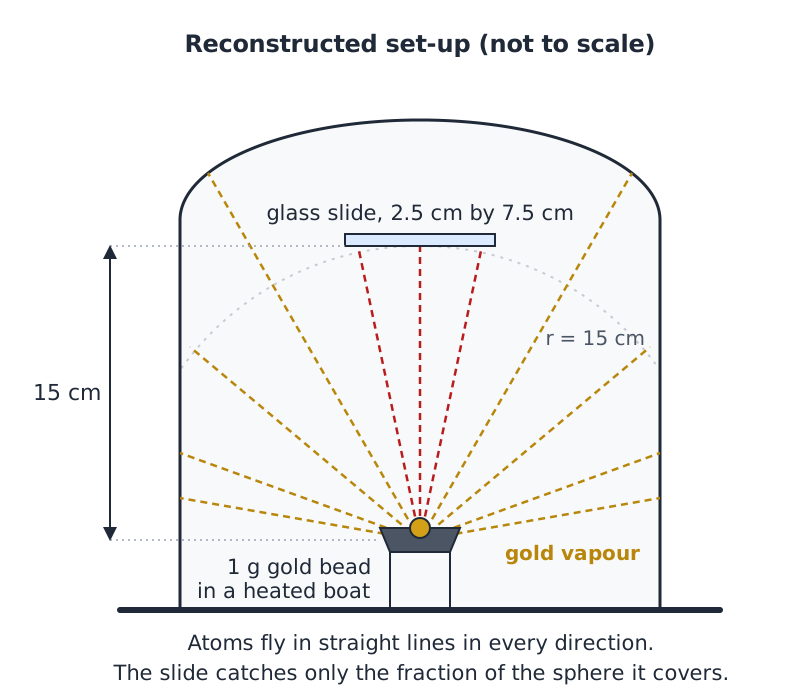{ width="560" }
*The reconstructed set-up. Drawn for this site (CC BY 4.0).*
## Why it is in the course
Session 6 closes Section 1, "Detecting Nonsense, Error Checking, False
Assumptions, Cherishing Mistakes". The readings due are a packet on valuing
mistakes and Ehrlich's introduction on judging a crazy idea. The syllabus
then names three skills for the hour — "Some ways to check for errors",
"hidden assumptions", "what is 'understand'?" — and lists Evaporated Gold
straight after them. That placement suggests it was the worked example. It
is a placement, not evidence.
The reconstruction above is built to exercise those three skills. List your
assumptions before you compute, while you can still attack them.
Cross-check by a route that shares no arithmetic with the first — harder
than it sounds, as the resolution shows. Then ask whether you *understand*
the number or have merely produced one. The same day the class begins
[Collective Reproduction](https://tyson-swetnam.github.io/aosd/problems/collective-reproduction/index.md), where the checking
has to be done on someone else's reasoning.
## Where it comes from
We do not know. No puzzle of this name has been found outside Winfree's own
schedule.
The physics behind the likeliest reading is ordinary. Vacuum evaporation —
heating a metal in a chamber pumped down to roughly 10^-4^ Pa, so atoms fly
in straight lines and condense on whatever they hit — is how thin metal
films are made, on electron-microscope specimens, mirrors and electrodes.
Gold suits order-of-magnitude work because two of its numbers are famous: a
density near 19.3 g/cm^3^, and a gram that beats out to about a square
metre of leaf. Thin gold is also optically strange, which is where part 4
comes from: Michael Faraday's 1857 Bakerian Lecture examined how gold films
thin enough to transmit light behave.
??? tip "Hints"
- Write the assumptions down first, apart from the calculation; the
ones you did not write down are the likeliest to be wrong.
- Thickness is volume over area. The volume follows from the density;
the area is the hard part.
- Ask what would look different if the film were ten times thicker, or
ten times thinner. An answer you can recognise as absurd is an answer
you can check.
- Atoms leaving a hot source in vacuum fly in straight lines in every
direction. What fraction can reach a slide of that size, that far
away?
??? success "Resolution"
**This resolves the reconstruction above, not a recovered original.**
*The hidden assumption.* At 19.3 g/cm^3^, 1.00 g of gold occupies about
0.052 cm^3^. If all of it landed on the slide (18.75 cm^2^), the film
would be 28 micrometres thick, some 100,000 atoms. But the vapour
leaves in every direction, spreading over roughly a sphere of radius
15 cm, area about 2,800 cm^2^, of which the slide intercepts 0.7 %.
Mean thickness there: about 180 nanometres, roughly 600 atoms at gold's
0.29 nm spacing. A boat standing on the baseplate radiates into
something nearer a hemisphere, so call the geometry good to a factor of
two. The gap between that quibble and the factor-of-150 blunder is the
lesson.
*Which checks are really checks.* Gold leaf looks like an independent
route and is not. A gram spread over a square metre is 52 nm thick; our
sphere has 3.5 times less area, so 3.5 times the thickness, 180 nm.
That is the same volume divided by an area — the answer re-derived, not
tested. Counting atoms against Avogadro's number tells the same story:
it checks the arithmetic, never the geometry, which is where the error
was. Two checks do bite. Real specimen coatings run 5 to 20 nm and use
far less than a gram, so a 28-micrometre film is absurd on its face.
And ask where the rest went: if 99.3 % misses the slide, the jar must
come out coated — a prediction the apparatus can falsify.
*Appearance.* At 180 nm the film is opaque and mirror-bright. Gold
turns semi-transparent only below a few tens of nanometres, and then
transmits greenish-blue, as Faraday found in 1857 — so the colour of
the slide tells you almost nothing beyond "thicker than about 50 nm".
## Sources
- **Arthur T. Winfree**, "The Art of Scientific Discovery": course handout and retrospective syllabus (479/479H/579, Ecology and Evolutionary Biology, University of Arizona), archived capture (2001) — [Wayback Machine](https://web.archive.org/web/20030111064604/http://eebweb.arizona.edu/faculty/winfree/Handout_479.htm){target=_blank} 🔓
- **Arthur T. Winfree**, faculty home page, archived 25 Dec 2002 — [Wayback Machine](https://web.archive.org/web/20021225142609/http://eebweb.arizona.edu/faculty/winfree/){target=_blank} 🔓
- **Michael Faraday**, "The Bakerian Lecture: Experimental Relations of Gold (and Other Metals) to Light", *Philosophical Transactions of the Royal Society of London* 147, 145–181 (1857) — [public-domain scan at Wikimedia Commons](https://commons.wikimedia.org/wiki/File:The_Bakerian_Lecture-_Experimental_Relations_of_Gold_(and_Other_Metals)_to_Light_(IA_jstor-108616).pdf){target=_blank} 🔓
- **Wikipedia contributors**, "Evaporation (deposition)" — [en.wikipedia.org](https://en.wikipedia.org/wiki/Evaporation_(deposition)){target=_blank} 🔓
- **Wikipedia contributors**, "Gold" — [en.wikipedia.org](https://en.wikipedia.org/wiki/Gold){target=_blank} 🔓
- **Wikipedia contributors**, "Fermi problem" — [en.wikipedia.org](https://en.wikipedia.org/wiki/Fermi_problem){target=_blank} 🔓
- **Wikipedia contributors**, "Fritz Haber" — [en.wikipedia.org](https://en.wikipedia.org/wiki/Fritz_Haber){target=_blank} 🔓
- **Fritz Haber**, "Das Gold im Meerwasser", *Zeitschrift für angewandte Chemie* (now *Angewandte Chemie*) 40(11), 303–314 (1927) — [doi:10.1002/ange.19270401103](https://doi.org/10.1002/ange.19270401103){target=_blank} 🔒
- **911 Metallurgist** (reprinting an older mining-engineering article), "How much Gold in Sea Water" — [911metallurgist.com](https://www.911metallurgist.com/blog/how-much-gold-sea-water/){target=_blank} 🔓
- **Robert Ehrlich**, *Nine Crazy Ideas in Science: A Few Might Even Be True* (2001) — [Princeton University Press](https://press.princeton.edu/books/paperback/9780691094953/nine-crazy-ideas-in-science){target=_blank} 🔒
- **Arthur T. Winfree**, *The Art of Scientific Discovery: original course syllabus* — [PDF](https://github.com/tyson-swetnam/aosd/blob/main/docs/assets/aosd_syllabus.pdf){target=_blank} 🔓
!!! note "How sure are we that this is Winfree's problem?"
Not at all. The syllabus gives the name and nothing else, the archived
handout carries no statement for it, Winfree's other archived pages say
nothing about gold, and no published puzzle of this name turned up
elsewhere. Three readings were weighed, and all three are low
confidence.
- **A thin-film thickness estimate**, used above. "Evaporated gold" is
the standard laboratory phrase for vapour-deposited gold, and the
syllabus promises exercises "made from elementary mathematics so as
to require no lab setup". Two things in the syllabus cut against it.
The exercises are meant to "depend as little as possible on knowledge
of any particular subject area", and this one leans on physics. And
the puzzles are "many of them silly", meant "to slow you down for a
few minutes"; every Section 1 neighbour is short and whimsical, while
this reconstruction is a multi-part calculation.
- **Gold from seawater.** Old assays put tens of milligrams of gold in
a tonne of seawater. Fritz Haber's 1920s scheme to extract it for
German reparations found the true figure a thousand times smaller:
the old numbers came from contaminated reagents. A fine "valuing
mistakes" story — but the syllabus says nothing of the sea.
- **A Fermi estimate**: spread all the gold ever mined over the Earth
and say how thick the layer is. Nothing ties it to Winfree.
If you know the original, the editors would like to hear from you.
---
*Back to [Section 1](https://tyson-swetnam.github.io/aosd/section1/index.md) · [All problems](https://tyson-swetnam.github.io/aosd/problems/index.md) · [The schedule](https://tyson-swetnam.github.io/aosd/syllabus/index.md#section-1-detecting-nonsense-error-checking-false-assumptions-cherishing-mistakes)*