Slide 17 · Hallucination is an engineering problem
Revised deck. The revised deck (2026-10-31) removes the GNoME example and "every output is a hypothesis" (
c5–c6superseded). The ontology control now runs on slide 26's NEON ground-beetle terms, not the earlier mouse, RNA-seq and HeLa examples. The schema-row rewording (c3) is agreed but not yet in the deck.
Section: 01 · Fear · Slide text and notes: talk/slides.md
Notes: Every objection in the first column is real, and every one of them is a missing engineering control, not a property of the model. The four controls (MCP tools, ontology validation, schema-constrained output, provenance) come back in section three.
Each control on the slide is built and run here against real data. The shared pieces live in evidence/ because sections 03 and 19 reuse them:
| Module | What it does |
|---|---|
citations.py |
Citation checker |
ontology.py |
OLS4 term validation |
http.py |
Cached, rate-polite API access |
Findings
| Objection → control | Test | Result | Claim |
|---|---|---|---|
| "It invents citations" → call a real index | 100 hallucinated citations from accepted NeurIPS 2025 papers (GPTZero) and 141 real references (BloombergGPT) | 99/100 hallucinated flagged; 77% of real ones verified automatically, 22% sent to review, 1.4% false mismatches | ✅ c1 |
| "It makes up metadata" → terms must resolve in an ontology | Slide 26's 12 NEON-beetle variants plus four model-style errors, checked live against OLS4 | all four errors refused; 6 variants written as names, 6 sent to review as mappings | ✅ c2 |
| "It varies run to run" → a JSON schema | Eight outputs against a draft 2020-12 schema | six malformed outputs refused; a well-formed record with a fake DOI passed | 🟧 c3 |
| "I cannot audit it" → provenance in DuckLake | An agent session logged, then its record overwritten | time travel recovers the original; all three tool calls replay with identical hashes | ✅ c4 |
| GNoME: "380,000 crystals; labs confirmed under 5%" | The paper's own full text; the critique's metadata from the DOI registry | 381,000 stable; 736 (0.19%) already made in labs, which is not a confirmation rate | ❌ c5 |
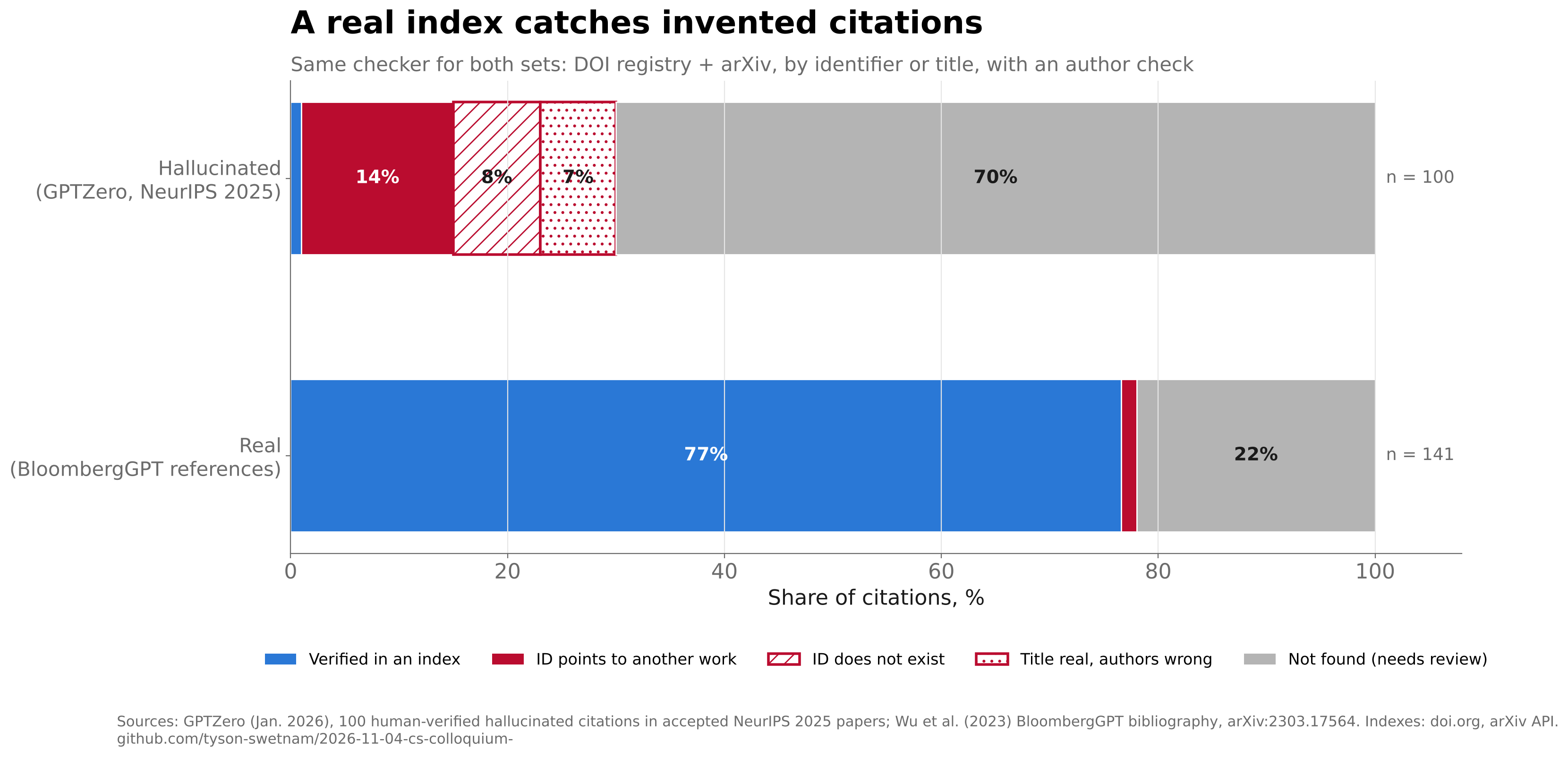
What the citation test shows
- Two indexes are enough to start. The checker uses only the DOI registry and arXiv.
- It never confirmed a fabricated identifier. It catches IDs that point to another paper (14), IDs that don't exist (8), and real titles with invented authors (7).
- The 70 hallucinations it couldn't place are flagged, not passed. They go to a person.
- Real references fail for knowable reasons. The 33 it couldn't confirm are pre-arXiv classics, technical reports and workshop papers, plus two whose registry metadata changed.
- More indexes would shrink the review queue. Crossref, OpenAlex, Semantic Scholar and DBLP would cut the 22%. From this environment they were rate-limited or behind a bot challenge.
What the schema test shows
The objection is about variation, but a schema only fixes the form of an answer. Combine it with the citation and ontology checks to control the content. The record that passed the schema used a fake DOI taken from GPTZero's NeurIPS list, and control 1 rejects it. Run-to-run variation in content wasn't measured, because there's no model API in this environment.
GNoME, the slide's example
"…the identification of 2.2 million crystal structures, of which 381,000 are newly discovered stable materials." "Of the stable structures, 736 have already been independently experimentally realized." (Merchant et al., Nature 2023)
- 736 is not a pass rate. It counts structures other labs had already made. The other 99.8% have not been tried, not failed.
- The critique is about novelty and usefulness. Cheetham & Seshadri (Chem. Mater. 36, 3490, 2024) found "scant evidence for compounds that fulfill the trifecta of novelty, credibility, and utility."
The example still serves the slide's point ("every output is a hypothesis until it is checked"), worded accurately:
Suggested: Google DeepMind's GNoME predicted 381,000 new stable crystals; 736 (0.2%) had been made in a lab, and critics found few that were both new and useful.
Notes for later slides
- Slide 26, OBI label. OBI's preferred label for OBI:0001271 is "transcription profiling by RNA sequencing assay"; "RNA-seq assay" is its alternative label.
- Slide 26, "transcriptome". The validator refuses it as a name, so present it as a curator's mapping.
- Slide 26, hierarchy. The claim checks out: Mammalia (NCBITaxon:40674) is an ancestor of Mus musculus.
- Slide 21. DuckLake's time travel and snapshot log, shown here, are the evidence for the lakehouse slide too.
Reproduce
make slide-06
| Script | What it does |
|---|---|
01_citations.py |
Citation checks (about 30 minutes on the first run because of arXiv's 3 s rate limit; then cached) |
02_ontology.py |
Ontology write checks against OLS4 |
03_schema.py |
JSON Schema checks |
04_provenance.py |
DuckLake logging and replay |
05_gnome.py |
GNoME figures from the paper's full text |
06_figures.py |
The citation chart |
API responses are cached in data/cache/, which is not committed. The GPTZero table is saved as gptzero_neurips_2025_hallucinations.csv.
Claims
| Claim | Status | Kind | |
|---|---|---|---|
c1 | “It invents citations” → the agent must call a real index | ✅ supported | technical |
c2 | “It makes up metadata” → terms must resolve in an ontology | ✅ supported | technical |
c3 | “It varies run to run” → a JSON schema, validated in the agent Suggested: “It varies run to run” → a JSON schema fixes the shape; controls 1-2 check the content | ✏️ revise-slide | technical |
c4 | “I cannot audit it” → provenance in DuckLake; replay any run | ✅ supported | technical |
c5 | Google DeepMind's GNoME proposed 380,000 crystals; independent labs confirmed under 5% | 🗄️ superseded | attribution |
c6 | Every output is a hypothesis until it is checked | 🗄️ superseded | qualitative |
Source: slides/17-hallucination-is-engineering · open the deck